The Legacy of the Asscher Cut
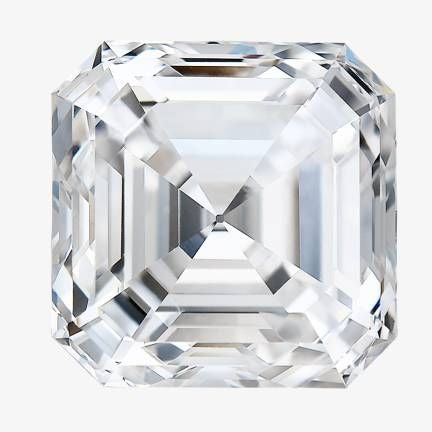
The Asscher cut was created in 1902 by Joseph Asscher of the Royal Asscher Diamond Company in Amsterdam — a firm so respected that it was entrusted with cleaving the 3,106-carat Cullinan Diamond, the largest gem-quality rough diamond ever found. The cut that bears the family name was designed as a square step cut with deeply cropped corners and a high crown, producing a distinctive light pattern that no existing shape could replicate.
What made the Asscher revolutionary was its optical effect. Unlike the emerald cut — which produces horizontal planes of mirror-like light — the Asscher's square symmetry creates concentric, nested rectangles of light that appear to recede into the stone's center. Gemologists describe this as the "infinite corridor" or "staircase" effect — a hypnotic, almost three-dimensional depth visible through the stone's broad table. Looking into an Asscher doesn't feel like looking at a surface. It feels like looking down into an illuminated well.
The cut experienced its first peak of popularity during the Art Deco era of the 1920s and 1930s, when its geometric precision aligned perfectly with the period's obsession with symmetry, structure, and architectural ornament. After decades of quieter appreciation, the Asscher has experienced a significant resurgence — driven by buyers who've exhausted their interest in brilliant cuts and want something with more history, more depth, and more visual gravity.
In moissanite, the Asscher reaches a level of luminosity that diamond can only approach. Moissanite's refractive index of 2.65 produces broader, brighter step-facet flashes than diamond's 2.42, making the concentric light patterns more vivid and the corridor effect more immersive. The shape that was already the most mesmerizing step cut becomes genuinely transcendent in the most brilliant step-cut stone.
Benefits of Asscher Moissanite Stones
The Most Hypnotic Light Pattern in Gemstones
No other shape produces the Asscher's signature concentric effect. The square step facets create nested rectangles of light that appear to stack inward toward the stone's center — a geometric depth illusion that's impossible to replicate in brilliant cuts or even in the emerald. The effect is meditative, almost trance-like. People who look into an Asscher don't glance and move on. They pause. They lean in. They look again. That magnetic quality is the Asscher's defining gift.
Art Deco Heritage Built Into the Shape
The Asscher is the only gemstone shape that carries a specific historical era in its visual DNA. Its clean geometry, mathematical symmetry, and structured light behavior are pure Art Deco — the same design principles that produced the Chrysler Building, Cartier's geometric jewelry, and the ornamental patterns of the 1920s. Choosing an Asscher isn't just choosing a shape. It's choosing an aesthetic lineage that connects your piece to one of the most celebrated design movements in history.
Square Symmetry with Step-Cut Depth
The Asscher combines the square footprint of a princess cut with the step-cut philosophy of an emerald — creating a shape that's geometrically balanced while producing transparent, layered light rather than scattered sparkle. This gives the Asscher a unique position: it has the structural presence of a square shape with the sophisticated calm of a step cut. No other shape occupies this intersection.
Deeply Cropped Corners Create an Octagonal Impression
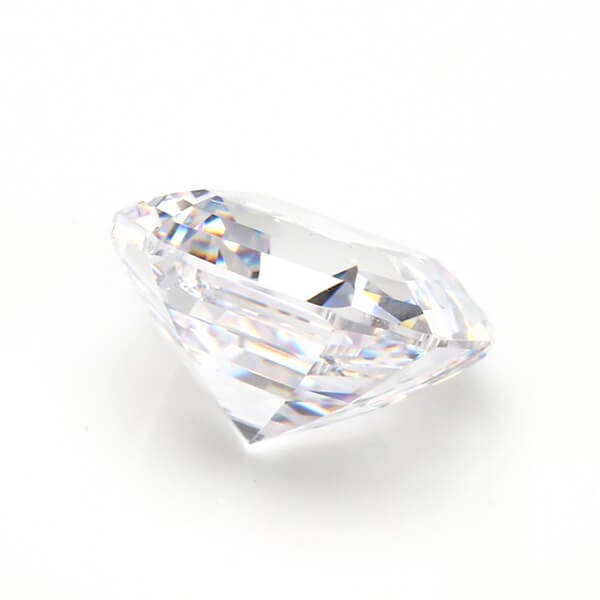
The Asscher's corners are cut more deeply than the emerald's, giving the stone an almost octagonal appearance from certain angles. This distinctive octagonal quality sets the Asscher apart from every other rectangular or square shape — it reads as more complex, more intentional, and more visually distinctive than a standard square or rectangle. The deeply cropped corners also eliminate chipping vulnerability, making the Asscher structurally robust despite its refined appearance.
Asscher Moissanite vs Other Shapes
The Asscher occupies such a specific aesthetic niche that comparing it to other shapes is really about understanding which philosophy of light and design resonates with you.
Compared to round moissanite, the Asscher is its philosophical opposite. The round maximizes outward brilliance — light returning from the stone in every direction as fast and intensely as possible. The Asscher maximizes inward depth — light organized into geometric planes that pull the viewer's gaze into the stone. The round is extroverted sparkle. The Asscher is introverted gravity. If you want a stone that catches everyone's eye from across the room, choose the round. If you want a stone that holds one person's gaze indefinitely, choose the Asscher.
Compared to pear moissanite, the Asscher offers structured stillness where the pear offers directional movement. The pear's teardrop draws the eye along its length — dynamic, flowing, dramatic. The Asscher draws the eye inward toward its center — still, geometric, contemplative. The pear moves. The Asscher anchors. They exist at opposite ends of the visual energy spectrum.
Compared to princess moissanite, the Asscher shares a square footprint but delivers a completely different experience. The princess uses brilliant-cut chevron facets to produce intense, scattered fire — geometric sparkle at maximum energy. The Asscher uses step facets to produce layered, transparent depth — geometric calm at maximum refinement. The princess is a square that dazzles. The Asscher is a square that mesmerizes. If you want geometric shape with brilliant energy, choose the princess. If you want geometric shape with hypnotic depth, choose the Asscher.
Compared to the emerald, the Asscher is its square sibling — same step-cut philosophy, different proportions. The emerald's rectangular outline produces horizontal planes of light that sweep across the stone's length. The Asscher's square outline produces concentric planes that recede into the stone's center. The emerald is a window. The Asscher is a well. Both are step cuts. Both are architectural. But they create fundamentally different spatial experiences — one horizontal, one vertical.
For those who've decided the Asscher is their shape and want to see it in a finished ring, our Asscher moissanite engagement rings collection showcases this cut across solitaires, Art Deco vintage settings, three-stone configurations with baguette flanks, bezel settings, and geometric halo designs — demonstrating the full range of what the Asscher's hypnotic depth becomes when set in expert metalwork.
Understanding Clarity and Color in Asscher Cuts
Like the emerald, the Asscher is a transparency-forward shape — its broad, open step facets reveal the stone's interior with unforgiving honesty. But the Asscher's square symmetry and concentric light pattern make clarity and color even more consequential than in the emerald.
In an emerald cut, the eye sweeps horizontally across the rectangular surface. In an Asscher, the eye is drawn directly into the center of the stone through nested geometric frames. Any inclusion or color inconsistency near the center becomes the focal point of the entire viewing experience — because that's exactly where the eye naturally rests.
At Grown Leo, our grading for Asscher moissanite prioritizes center-zone clarity and color above all else. We evaluate how the stone looks through its own concentric light pattern — not against generic grading benchmarks designed for brilliant cuts. Every Asscher in this collection has been selected for clean, consistent depth that rewards the close inspection this shape invites.
Available Sizes
This collection spans the full carat range for Asscher moissanite.
Small calibrated stones (under 0.25 carats, approximately 3.0–3.5mm) are available for accent work — side stones in geometric ring designs, Art Deco-inspired multi-stone compositions, and step-cut eternity bands. Small Asscher accents add a structured, vintage-forward character that round and princess accents can't provide.
Mid-range stones (0.50–1.50 carats) serve as center stones for engagement rings, pendants, and individual earring gems. A 1 carat Asscher measures approximately 5.5mm x 5.5mm — a compact, deeply architectural square that reveals the full concentric light pattern and corridor effect at a wearable, everyday size. At this weight, the Asscher's distinctive depth is clearly visible and unmistakably different from any brilliant cut.
Large center stones (2.00–3.00+ carats) are where the Asscher becomes genuinely captivating. A 2 carat Asscher measures roughly 7.0mm x 7.0mm. A 3 carat reaches approximately 8.0mm x 8.0mm. At these sizes, the concentric light corridors deepen dramatically — the nested rectangles of light become wide enough to observe individually, and the stone's center appears to recede into a luminous depth that's almost immersive. A 3 carat Asscher moissanite doesn't sit on the finger. It opens a geometric portal into light.
Moissanite vs Diamond in Asscher Cut
The Asscher is the shape where the comparison between moissanite and diamond becomes most nuanced — because the step-cut format reveals differences in light behavior that brilliant cuts often obscure.
Diamond's lower refractive index (2.42) produces step-facet flashes that are cooler, more muted, and more traditionally diamond-like. Moissanite's higher refractive index (2.65) produces step-facet flashes that are broader, brighter, and carry more internal luminosity. In the Asscher — where individual light planes are large enough to examine closely — this difference is visible and meaningful. A diamond Asscher has a subdued, icy elegance. A moissanite Asscher has a warmer, more radiant luminosity.
Dispersion adds another dimension. Moissanite's 0.104 versus diamond's 0.044 means the concentric light flashes in a moissanite Asscher carry subtle spectral color at their edges — warm hints of rainbow that add life and visual interest to the geometric patterns. Diamond Asschers lack this quality, which can make them appear flatter and less animated in certain lighting conditions.
The cost gap is dramatic. A loose 1 carat Asscher diamond of decent quality costs $3,000 to $8,000. A 2 carat runs $8,000 to $23,000. A 3 carat reaches $18,000 to $50,000 or more. Premium loose Asscher moissanite from Grown Leo costs a fraction of these ranges — with a luminosity and depth that many buyers prefer once they've compared both stones in person.
Every stone is lab created — ethically sourced, conflict-free, and produced without mining. A shape with a century of master craftsmanship in its heritage deserves sourcing that's equally considered.
What You Can Build with Asscher Moissanite
The Asscher's geometric precision and Art Deco heritage naturally channel it toward designs that emphasize structure, symmetry, and historical reference.
In an engagement ring, the Asscher finds its most iconic expression in Art Deco-inspired settings — geometric metalwork, milgrain borders, step-tiered galleries, and symmetrical side stone arrangements that echo the stone's own concentric patterns. A solitaire setting with clean prongs showcases the stone's unadorned depth. A bezel setting frames the Asscher's octagonal impression within a metal border that emphasizes its unique corner geometry. A three-stone design with baguette or trapezoid side stones extends the step-cut language across the finger in a composition that feels historically grounded and architecturally complete.
In a pendant, an Asscher moissanite hangs with composed, geometric authority — the square shape drops from a bail with structural poise that rounds and ovals can't match. An Art Deco-style pendant frame with geometric metalwork details creates a piece that could have come from a 1920s Parisian jeweler's case.
In earrings, Asscher studs deliver something no other stud shape offers — concentric depth visible at ear level, catching light in geometric patterns that are distinctly different from the scattered sparkle of round or princess studs. Asscher drops add architectural movement below the earlobe.
For step-cut eternity bands and channel-set bracelets, calibrated Asscher stones create a continuous surface of geometric depth that's uniquely sophisticated — each square stone's concentric pattern interlocking visually with its neighbor's.
Quality Standards at Grown Leo
The Asscher is the most quality-sensitive shape in our catalog alongside the emerald — and in some respects, it demands even more precision. The square symmetry means any deviation from perfect proportions is immediately visible. A rectangle can tolerate slight asymmetry because the eye reads it as an elongated shape. A square cannot. If one side is even marginally longer than another, the eye catches it instantly.
Every Asscher moissanite in this collection is graded for four-sided symmetry (all sides measured for equality), step-facet parallelism, corner depth consistency (all four cropped corners matching), table centering, pavilion alignment, and overall light performance. We evaluate each stone's concentric corridor effect specifically — confirming that the nested rectangular reflections are clean, centered, and evenly distributed.
Center-zone clarity is assessed under magnification and to the naked eye. Color is evaluated through the stone's own concentric light pattern, which can amplify even minor color variations at the center where the eye naturally focuses.
Each stone ships with a certificate of authenticity confirming carat weight, dimensions, cut grade, and quality metrics. Packaging is designed for secure transit. Every U.S. order ships free with full insurance.