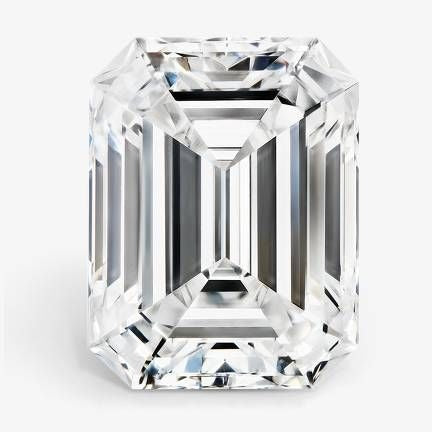
The History and Philosophy of the Emerald Cut
The emerald cut takes its name from the technique originally developed to cut emerald gemstones — a mineral so prone to internal fractures that cutters needed a shape with broad, flat facets and cropped corners to reduce stress during the cutting process. When the technique was applied to diamonds and later to moissanite, it produced something unexpected: a shape whose optical behavior was fundamentally different from every brilliant cut in existence.
Where brilliant cuts are designed to maximize light return — breaking incoming light into as many outgoing flashes as possible — the step cut does the opposite. It organizes light into broad, deliberate planes. Long, parallel facets create a layered transparency that lets the viewer see into the stone rather than seeing light bounce off its surface. The result is what gemologists call the "hall of mirrors" effect — a series of concentric rectangular reflections that recede into the stone's depth like reflections between two facing mirrors.
This isn't a deficit in sparkle. It's an entirely different philosophy of what a gemstone should do with light. Brilliant cuts perform. The emerald cut reveals. And for those who find beauty in transparency, depth, and structural precision rather than in raw scintillation, the emerald cut isn't just another option. It's the only real choice.
In moissanite, the emerald cut gains an advantage that diamond can't match. Moissanite's refractive index of 2.65 produces broader, more vivid step-facet flashes than diamond's 2.42. The hall of mirrors is brighter. The planes of light are more defined. The transparency is more luminous. The result is a step cut that retains the emerald's signature calm while adding a vibrancy that diamond emeralds can't quite reach.
Benefits of Emerald Moissanite Stones
Unrivaled Depth and Transparency
No other shape lets you see into the stone the way an emerald does. Its broad, open facets create a window into the gem's interior — layers of light visible at different depths, each facet reflecting the one above and below it. This transparency gives the emerald cut a three-dimensional quality that brilliant cuts flatten into surface-level sparkle. When you look at a round brilliant, you see light. When you look at an emerald, you see the stone itself.
Architectural Elegance
The emerald cut's rectangular outline, parallel facets, and cropped corners create a geometry that reads as intentionally designed rather than naturally occurring. It's the most architectural gemstone shape — clean lines, defined edges, mathematical symmetry. This quality makes the emerald the natural choice for those who appreciate design in its purest form — structure, proportion, and deliberate restraint over decorative excess.
The Largest Face-Up Appearance
The emerald cut has a shallower depth profile than most brilliant cuts, which means more of its carat weight is distributed across the stone's surface rather than hidden beneath it. A 1 carat emerald presents a larger face-up surface than a 1 carat round — the stone appears physically bigger because its proportions prioritize what you see over what sits below the setting. This size advantage makes the emerald one of the most visually efficient shapes per carat.
Calm, Deliberate Light Behavior
Where brilliant cuts produce rapid, fragmented scintillation, the emerald produces slow, sweeping flashes that move across the stone in broad, defined planes. The light behavior is calm, controlled, and hypnotic — it rewards sustained attention rather than demanding it. For many wearers, this understated quality is more captivating than any amount of scattered fire. The emerald doesn't shout. It draws you in.
Emerald Moissanite vs Other Shapes
The emerald occupies such a distinct position in the gemstone world that comparing it to brilliant cuts is less about which is better and more about which philosophy of light appeals to you.
Compared to round moissanite, the emerald delivers a fundamentally different visual experience. The round maximizes scattered brilliance — light returning in hundreds of small, uniform flashes from every direction. The emerald minimizes scatter and maximizes depth — light returning in broad, deliberate planes that reveal the stone's interior structure. The round is objectively more sparkly. The emerald is objectively more transparent. Choose the round if you want maximum fire. Choose the emerald if you want maximum sophistication.
Compared to pear moissanite, the contrast is between controlled restraint and directional drama. The pear's asymmetric teardrop commands attention through its singular, flowing silhouette. The emerald commands attention through its stillness — a geometric window of light that doesn't need movement to be compelling. The pear is the extrovert. The emerald is the introvert who somehow commands the room without raising its voice.
Compared to princess moissanite, the emerald shares a rectangular family resemblance but delivers the opposite light behavior. The princess uses brilliant-style chevron facets to produce intense, scattered fire within a square outline. The emerald uses step facets to produce layered, transparent depth within a rectangle. The princess is geometry with sparkle. The emerald is geometry with soul. If you want a rectangle that dazzles, choose the princess. If you want a rectangle that mesmerizes, choose the emerald.
Compared to the radiant, the emerald is its philosophical opposite despite sharing the same rectangular outline with cropped corners. The radiant combines the emerald's shape with brilliant-cut faceting — producing the crushed-ice intensity the emerald deliberately avoids. The radiant is the emerald for people who can't give up sparkle. The emerald is the emerald for people who've moved beyond needing it.
For those who've already decided the emerald is their shape, our emerald moissanite engagement rings collection showcases this cut across solitaires, three-stone settings with trapezoid flanks, Art Deco vintage designs, and sleek modern settings — demonstrating the full range of what the emerald's architectural elegance can become when paired with expert craftsmanship.
Understanding Clarity and Color in Emerald Cuts
The emerald cut's transparent, open facets reveal more of a stone's internal characteristics than any other shape. In a round brilliant, the scattered sparkle pattern masks minor color tinting and small inclusions behind a curtain of flashing light. The emerald cut removes that curtain entirely. What exists inside the stone is visible — plainly, beautifully, and unforgivingly.
This transparency makes clarity and color grading more important for emerald cuts than for any other shape. A minor inclusion that would disappear in a round can become a visible feature in an emerald. A slight warmth in color that would be undetectable in a cushion can be perceptible in an emerald's calm, undisturbed light.
At Grown Leo, our grading standards for emerald moissanite reflect this reality. We select only stones with the color consistency and internal clarity necessary to perform in the most transparent shape available. Every emerald in this collection has been evaluated specifically for how it looks through its open facets — not just on paper, but to the naked eye under real-world lighting conditions.
Available Sizes
This collection spans the full carat range for emerald moissanite.
Small calibrated stones (under 0.25 carats, approximately 3.0–4.5mm in length) are available for accent work — side stones in three-stone settings, channel-set bands, and multi-stone compositions. Small emerald-cut accents add geometric, Art Deco character that rounds can't provide.
Mid-range stones (0.50–1.50 carats) serve as center stones for engagement rings, pendants, and individual earring gems. A 1 carat emerald measures approximately 6.5mm x 4.5mm — a clean, architectural rectangle that sits with quiet authority in any setting. At this size, the hall-of-mirrors effect is clearly visible and the stone's transparent depth is fully expressed.
Large center stones (2.00–3.00+ carats) are where the emerald cut becomes transcendent. A 2 carat emerald measures roughly 8.0mm x 6.0mm. A 3 carat reaches approximately 9.5mm x 7.0mm. At these sizes, the step-cut depth becomes genuinely immersive — looking into the stone feels almost like looking through a window into illuminated space. The broad facets at this scale produce dramatic, slow-moving flashes of light that are unmistakable from across a room. The emerald at 3+ carats isn't just a gemstone. It's an experience.
Moissanite vs Diamond in Emerald Cut
The emerald cut is the one shape where moissanite and diamond differ most visibly — and where moissanite's advantage is most debatable, because the comparison becomes a matter of preference rather than pure optical metrics.
Diamond's lower refractive index (2.42) produces step-facet flashes that are subtler, cooler, and more muted. Moissanite's higher refractive index (2.65) produces step-facet flashes that are broader, more vivid, and more luminous. Neither is wrong — but they create distinctly different experiences in the emerald format. A diamond emerald whispers. A moissanite emerald speaks clearly.
Where there's no debate is dispersion. Moissanite's 0.104 versus diamond's 0.044 means the flashes of light exiting a moissanite emerald carry more spectral color — subtle rainbow edges that add warmth and life to the stone's broad planes of light. In an emerald cut, where individual flashes are large enough to observe closely, this added color dimension is genuinely visible and adds a quality that diamond emeralds lack.
The cost gap is substantial. A loose 1 carat emerald diamond of decent quality costs $3,000 to $9,000. A 2 carat runs $8,000 to $25,000. A 3 carat reaches $20,000 to $55,000 or more. Premium loose emerald moissanite from Grown Leo costs a fraction of these ranges — with a light performance that many buyers prefer to diamond once they've seen both in person.
Every stone is lab created — ethically sourced, conflict-free, and produced without mining. The most refined, most deliberate gemstone shape deserves the most responsible sourcing.
What You Can Build with Emerald Moissanite
The emerald cut's architectural character lends itself to designs that emphasize structure, symmetry, and intentional composition.
In an engagement ring, the emerald is at its finest in settings that honor its geometry. A solitaire with clean prongs or a sleek east-west setting showcases the rectangular silhouette without distraction. A three-stone design with trapezoid or baguette side stones extends the geometric language across the finger — one of the most iconic and sophisticated ring compositions in jewelry. An Art Deco vintage setting with milgrain and geometric metalwork creates a perfect period-authentic aesthetic — the emerald cut and Art Deco were made for each other.
In a pendant, an emerald moissanite hangs with composed, vertical elegance. The rectangular shape drops from a bail with architectural poise — longer than a round, more structured than an oval, carrying a formality that suits both simple chains and elaborate settings.
In earrings, emerald-cut studs deliver something entirely different from round studs — calm, mirror-like flashes at ear level that read as quietly luxurious. Emerald drops add geometric movement below the earlobe. Matched emerald pairs are increasingly popular for those who want their everyday earrings to carry distinctive, understated character.
For tennis bracelets and eternity bands, emerald-cut stones set end-to-end create a continuous ribbon of step-cut light — a sleek, geometric alternative to round-stone designs that has become one of the most requested bracelet formats in modern fine jewelry.
Quality Standards at Grown Leo
The emerald cut is the most quality-demanding shape in our catalog. Its transparent facets expose everything — every nuance of color, every internal characteristic, every degree of cut precision. Standards that are acceptable in brilliant cuts become disqualifying in an emerald.
Every emerald moissanite in this collection is individually graded across a specific set of criteria tailored to this shape. Step-facet alignment is evaluated for parallel precision — any deviation from perfectly parallel lines disrupts the hall-of-mirrors effect. Corner symmetry is measured to ensure all four cropped corners are equal. Table size and pavilion depth are assessed for the proportions that produce the cleanest, most luminous transparency.
Color is evaluated under the stone's own light behavior — not under the same criteria used for brilliant cuts. An emerald reveals color differently than a round, and our grading accounts for this. Clarity is assessed through the stone's open facets as they appear to the naked eye — because that's how the wearer will see them.
Proportion ratios are documented for every stone. The classic emerald ratio falls between 1.30 and 1.60 — from nearly square to distinctly rectangular. We offer stones across this range so you can choose the exact silhouette that matches your design vision.
Each stone ships with a certificate of authenticity confirming carat weight, dimensions, proportion ratio, cut grade, and quality metrics. Packaging is designed for secure transit. Every U.S. order ships free with full insurance.