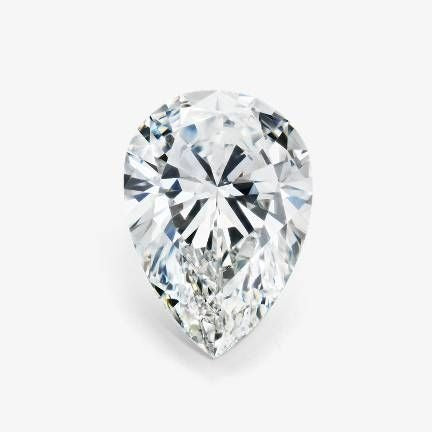
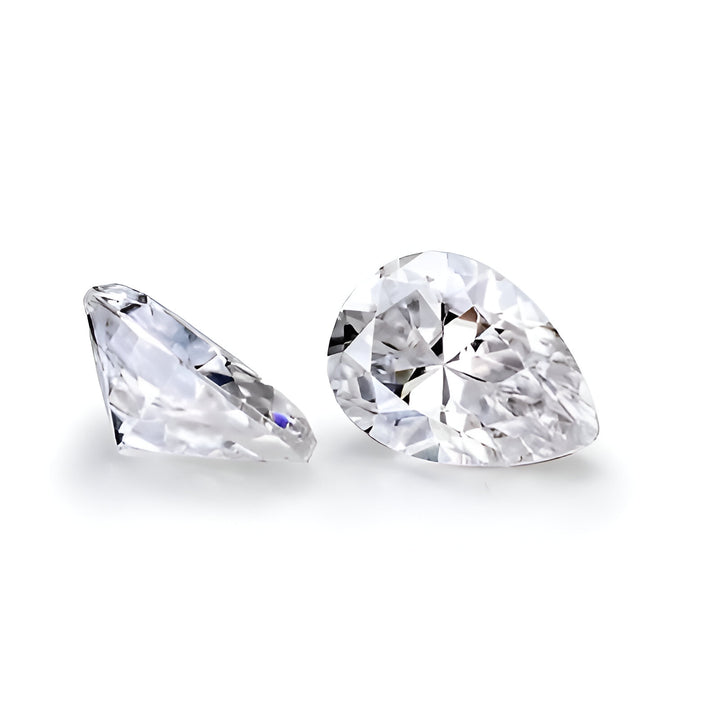
The History and Character of the Pear Cut
The pear cut — also called the teardrop cut — was developed in the 1400s by Flemish diamond cutter Lodewyk van Berquem, who is also credited with inventing the diamond polishing wheel. It's one of the oldest fancy shapes in gemstone history and one of the most enduring, remaining popular across six centuries of changing tastes and trends.
The shape's longevity comes from its unique duality. The rounded end provides the brilliant sparkle of a round cut. The pointed end provides the elongated drama of a marquise. Together, they create a silhouette that's unlike any other — directional, flowing, and inherently dynamic. A pear-shaped stone doesn't just sit in a setting. It points. It draws the eye along its length. It creates visual movement even when it's perfectly still.
In moissanite, the pear cut becomes exceptionally vivid. Moissanite's refractive index of 2.65 and dispersion of 0.104 amplify the pear's modified brilliant faceting, producing rainbow fire and white brilliance that exceed what a pear diamond can generate. The teardrop shape's natural elegance becomes luminous — a gem that moves light with the same grace as its silhouette suggests.
Benefits of Pear Moissanite Stones
The Most Visually Dramatic Fancy Shape
The pear's asymmetric outline is inherently more eye-catching than symmetrical shapes. Where rounds, squares, and ovals are balanced and predictable, the pear introduces directionality — a visual vector that guides the eye from rounded base to pointed tip. This makes pear-shaped stones the most dynamic option for jewelry where movement and drama matter. In pendants, the point hangs downward with natural gravity. In rings, the point can extend toward the fingertip or toward the wrist, creating two entirely different looks from the same stone.
Exceptional Apparent Size
The pear's elongated profile creates more surface area relative to its carat weight than a round of equivalent size. A 1 carat pear appears noticeably larger than a 1 carat round because its length-to-width ratio spreads the stone across more visual territory. This size advantage makes the pear an excellent value proposition — you get more perceived size per carat than most other shapes, which is especially meaningful at larger weights where every fraction of visual presence counts.
Unmatched Pendant Versatility
No other shape was as naturally designed for pendants as the pear. The teardrop silhouette hangs from a bail with inherent grace — the rounded end at the top, the point dropping downward, gravity and geometry working together perfectly. A pear moissanite pendant doesn't need elaborate metalwork to look finished. The shape itself does most of the design work. It's the only loose stone shape where the pendant application is arguably stronger than the ring application.
Finger-Slimming Effect
When set in a ring with the point extending toward the fingertip, the pear's elongated profile creates a visual lengthening effect that makes the finger appear slimmer and longer. This flattering quality is one of the reasons the pear has maintained consistent popularity in engagement rings — it doesn't just decorate the hand. It actually improves how the hand looks.
Pear Moissanite vs Other Shapes
Understanding how the pear compares to other cuts helps you decide whether its particular drama matches your vision — or whether a more conventional shape better serves the piece you're building.
Compared to round moissanite, the pear trades symmetrical uniformity for directional elegance. The round returns more total light due to its optimized facet geometry, but the pear creates more visual interest and appears larger at the same weight. Choose the round for maximum sparkle and universal safety. Choose the pear when you want the stone to feel like a design statement rather than a conventional choice.
Compared to oval moissanite, the pear shares an elongated profile but introduces asymmetry through its pointed tip. Both shapes maximize finger coverage and create a slimming effect. The oval is more balanced, more versatile, and easier to set. The pear is more dramatic, more distinctive, and more personality-driven. The oval suits those who want elongated elegance within a familiar framework. The pear suits those who want to break the frame entirely.
Compared to the marquise, the pear offers a gentler version of the same directional drama. The marquise points at both ends, creating maximum length but also maximum vulnerability at two tips. The pear points at one end and rounds at the other — retaining the elongated drama while providing one secure, chipresistant base. If the marquise feels too aggressive, the pear offers a softer, more wearable version of the same visual philosophy.
Compared to princess moissanite, the contrast is stark. The princess is geometric, angular, and architecturally modern. The pear is organic, flowing, and classically dramatic. They occupy opposite ends of the design spectrum — the princess for those who think in straight lines, the pear for those who think in curves. Neither is better. They serve entirely different aesthetic instincts.
For those who've decided the pear is their shape and want to see it in a finished ring, our pear moissanite engagement rings collection showcases the full range of settings designed specifically for this cut — solitaires with V-tip prongs, halos that follow the teardrop outline, vintage designs with ornate galleries, and three-stone configurations with complementary side stones.
Available Sizes
This collection spans the full carat range for pear moissanite.
Small calibrated stones (under 0.25 carats, approximately 3.0–5.0mm in length) are available for accent work — dangling earring drops, side stones in asymmetric ring designs, and decorative elements in multi-stone pieces. Small pear stones add a distinctive teardrop accent that no other shape can provide.
Mid-range stones (0.50–1.50 carats) serve as center stones for engagement rings, pendants, and individual earring gems. A 1 carat pear measures approximately 8.0mm x 5.0mm — noticeably longer than a 1 carat round (6.5mm diameter) and carrying more visual presence on the finger or at the neck. This is the most popular range for custom engagement ring builds and solitaire pendants.
Large center stones (2.00–3.00+ carats) are where the pear becomes genuinely breathtaking. A 2 carat pear measures roughly 10.0mm x 7.0mm. A 3 carat reaches approximately 12.0mm x 8.0mm — a stone that stretches across the full width and length of a ring setting with cinematic scale. At these sizes, the teardrop silhouette is unmistakable from across a room, and the fire radiating from moissanite's facets fills the entire elongated surface with light.
Moissanite vs Diamond in Pear Cut
The pear is one of the shapes where moissanite's optical advantages create the most visually compelling difference — because the elongated, asymmetric facet pattern gives light more diverse angles to interact with.
Moissanite's refractive index of 2.65 sends more light into the stone and returns more as brilliance. Its dispersion of 0.104 breaks that returning light into more vivid spectral colors. In the pear — where facets angle differently across the rounded base and the tapered point — these properties interact with a wider range of internal surfaces than in symmetrical shapes. The result is a sparkle that shifts character across the stone's length — warmer and broader at the base, sharper and more concentrated at the tip. Diamond can approximate this effect. Moissanite intensifies it.
The cost difference is clear at every size. A loose 1 carat pear diamond of decent quality costs $2,500 to $7,500. A 2 carat runs $7,000 to $22,000. A 3 carat reaches $15,000 to $45,000 or more. Premium loose pear moissanite from Grown Leo costs a small fraction of these ranges — with equal or superior visual performance. For a shape this distinctive, the fact that the more brilliant version is also the more affordable one makes the decision straightforward.
Every stone is lab created — ethically sourced, conflict-free, and produced without mining. The most timeless fancy shape deserves the most responsible modern gemstone.
What You Can Build with Pear Moissanite
The pear's directional silhouette creates unique design possibilities across every jewelry category.
In an engagement ring, a pear center stone offers two distinct orientations — point toward the fingertip for a lengthening effect, or point toward the wrist for a more traditional, grounding presence. Solitaire settings with V-tip prongs protecting the point are the most popular. Halo designs that follow the teardrop outline amplify the shape with a frame of accent stones. Three-stone settings pair the pear with round or marquise side stones for balanced asymmetry.
In a pendant, the pear is in its natural habitat. A single pear moissanite hanging from a simple bail is one of the most elegant and complete pendant designs possible — the shape provides all the visual interest the piece needs. The point hangs downward with gravitational logic, creating a teardrop silhouette that flatters the neckline without additional design complexity.
In earrings, pear-shaped drops add movement and length below the earlobe. They swing gently with head movement, catching light from changing angles in a way that static studs can't replicate. Matched pear pairs also work as distinctive studs — the teardrop on the ear reads as deliberately unconventional.
For custom pieces, pear stones bring personality to any format — asymmetric bracelets, multi-stone cluster rings, or mixed-shape compositions that combine pears with rounds and marquises for dynamic, nature-inspired designs.
A Note on the Pointed Tip
The pear's single pointed tip is its most distinctive visual feature — and its one structural consideration. While moissanite's 9.25 Mohs hardness provides excellent protection against scratching and everyday wear, the pointed end can chip if struck directly against a hard surface with concentrated force.
Proper setting technique eliminates this concern. V-tip prongs wrap the point in protective metal. Bezel settings enclose the entire perimeter. Halo designs surround the point with accent stones that act as a buffer. At Grown Leo, our pear stones are cut with clean, symmetrical points that pair properly with protective settings. If you're planning a ring, ensure your setting addresses tip protection — our team can recommend the best approach for your design.
Quality Standards at Grown Leo
The pear is the most difficult mainstream shape to cut symmetrically. Its asymmetric outline means the two halves of the stone must mirror each other precisely — the curve of the base must match on both sides, and the point must sit exactly centered between them. Any deviation produces a lopsided appearance that no amount of sparkle can compensate for.
Beyond symmetry, proportion matters enormously. The ideal pear length-to-width ratio falls between 1.50 and 1.75 for most jewelry applications — long enough to express the teardrop character, compact enough to avoid looking thin or fragile. Ratios outside this range can work for specific designs, but we document every stone's exact proportions so you know what you're getting.
Every pear moissanite in this collection is individually graded for bilateral symmetry, point centering, proportion ratio, facet alignment, color, clarity, and overall light performance. We evaluate for the specific characteristic that defines a successful pear — balanced, directional sparkle that's vivid at the base and sharp at the tip, with no dead zones, no bow-tie effect, and no areas where light fails to return.
Each stone ships with a certificate of authenticity confirming carat weight, dimensions, proportion ratio, cut grade, and quality metrics. Packaging is designed for secure transit. Every U.S. order ships free with full insurance.