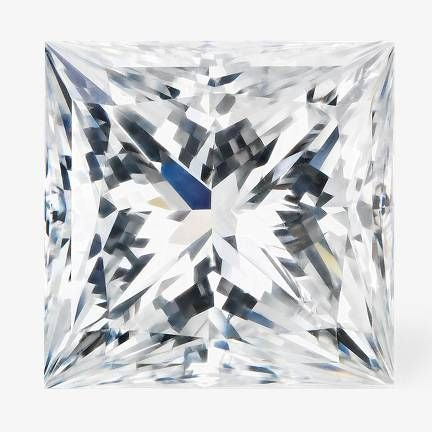
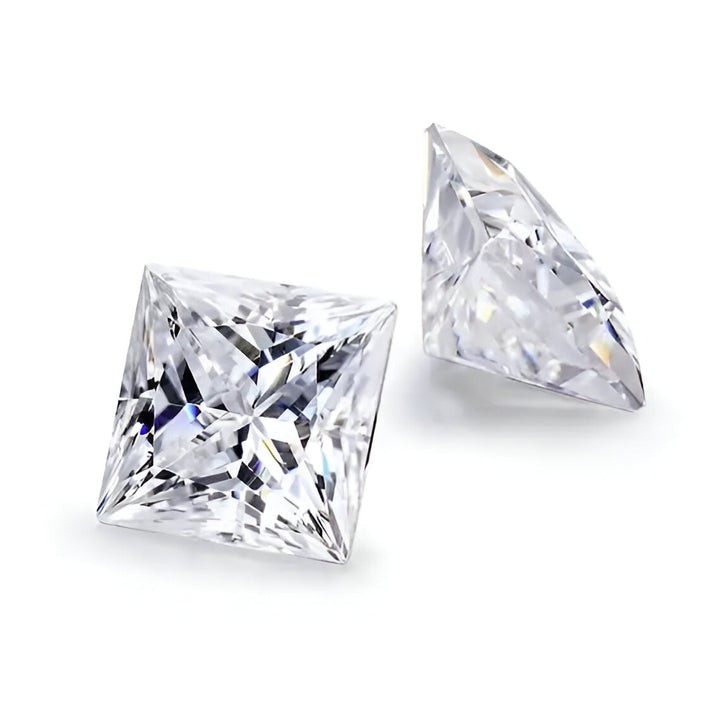
What Makes the Princess Cut Unique
The princess cut was developed in the 1960s and refined throughout the 1970s, emerging as the first square shape specifically designed for brilliant-style light performance. Before the princess, square gemstones meant step cuts — asschers, square emeralds — shapes that emphasized depth and clarity over dynamic sparkle. The princess changed that by arranging brilliant-cut facets in a chevron pattern beneath a flat, square table, creating a stone that returns light with an intensity rivaling the round brilliant but through a fundamentally different geometry.
The result is a sparkle pattern unlike any other shape. Where the round produces concentric, uniform brilliance, the princess produces a cross-pattern of light and dark facets that creates visual depth and movement within the square outline. The sparkle appears to radiate outward from the center in diagonal lines — energetic, structured, and distinctly modern. It's a sparkle that doesn't just catch light. It organizes it.
In moissanite, the princess cut reaches its full optical potential. Moissanite's refractive index of 2.65 and dispersion of 0.104 exceed diamond's, meaning the princess's chevron facets have more light to work with — producing broader spectral fire and more vivid brilliance than a princess diamond of identical cut quality. The square shape that was already the most modern brilliant cut becomes even more compelling in the most brilliant stone.
Benefits of Princess Moissanite Stones
Maximum Brilliance in a Square Format
The princess cut is the second most popular shape in the world — and the most popular non-round shape — precisely because it delivers brilliant-cut sparkle without the round's circular predictability. Its light return rivals the round brilliant's while its square outline provides a distinctly different aesthetic. For buyers who want maximum sparkle but don't want a round, the princess is the definitive answer.
Excellent Carat Retention
The princess cut is one of the most efficient shapes in terms of rough-to-finished yield. This means a higher percentage of the original moissanite material ends up in the finished gem — which translates to better value per carat compared to shapes like the round brilliant, where more material is lost during cutting. You get more stone for your investment.
Contemporary Design Language
The princess cut's clean edges, flat table, and sharp corners communicate a modern aesthetic that rounded shapes can't replicate. It reads as intentional, architectural, and design-forward — qualities that appeal to those who view their jewelry through a lens of personal style rather than convention. A princess stone in any setting feels like a choice, not a default.
Distinctive Sparkle Character
The princess cut's chevron faceting produces a sparkle pattern that's fundamentally different from rounds, ovals, or cushions. Rather than uniform scintillation, the princess creates a contrast pattern of bright and dark facets that produces visual depth — the stone appears to have an internal structure that catches and redirects light in organized, geometric patterns. This contrast gives the princess more visual complexity than shapes that produce homogeneous sparkle.
Princess Moissanite vs Other Shapes
Understanding how the princess compares to other popular cuts clarifies whether its particular character matches your vision.
Compared to round moissanite, the princess produces comparable total light return but distributes it through a square footprint with a chevron pattern rather than a circular one with concentric symmetry. The round is safer, more traditional, and slightly more light-efficient. The princess is bolder, more modern, and more geometric. If sparkle matters equally but shape matters more, the princess delivers the round's performance in a silhouette the round can't offer.
Compared to oval moissanite, the princess offers angular precision where the oval offers flowing curves. The oval appears larger at the same carat weight due to its elongated profile and creates a romantic, finger-flattering presence. The princess sits more compactly on the finger but with sharper visual definition. The oval feels organic. The princess feels engineered. Choose based on whether your aesthetic leans toward softness or structure.
Compared to pear moissanite, the princess provides symmetrical geometry where the pear provides asymmetric drama. The pear's teardrop is striking in pendants and distinctive ring settings, but its pointed end demands careful protection. The princess's four equal sides create balanced, predictable proportions that work across every jewelry format. The pear is the artist. The princess is the architect.
Compared to the cushion, the princess shares a roughly square footprint but with fundamentally different edges and faceting. The cushion softens its corners and uses open facets for warm, vintage-inspired flashes. The princess sharpens its corners and uses chevron facets for intense, modern brilliance. The cushion whispers. The princess declares.
For those ready to see the princess in a finished setting, our princess moissanite engagement rings collection showcases this cut across solitaires, halos, channel-set bands, and more — demonstrating exactly how the shape performs when paired with expert metalwork.
Available Sizes
This collection spans the full carat range for princess moissanite.
Small calibrated stones (under 0.25 carats, approximately 2.0–3.5mm) are available in matched batches for channel settings, invisible settings, eternity bands, and accent work. Calibrated princess cuts tessellate perfectly in channel-set bands and bracelets — their square shape creates seamless, edge-to-edge coverage that round stones can't achieve.
Mid-range stones (0.50–1.50 carats) serve as center stones for standard engagement rings, individual earring gems, and pendant stones. A 1 carat princess measures approximately 5.5mm x 5.5mm — a compact, concentrated square that sits neatly on the finger with a clean, defined presence. At this size, the chevron sparkle pattern is clearly visible and the stone carries genuine visual authority.
Large center stones (2.00–3.00+ carats) are where the princess becomes a true statement. A 2 carat princess measures roughly 7.0mm x 7.0mm. A 3 carat reaches approximately 8.0mm x 8.0mm. At these sizes, the chevron facet pattern becomes dramatic — the diagonal lines of light and contrast that define the princess are visible from across the room, and the square footprint covers substantial finger width with sharp, decisive presence.
Moissanite vs Diamond in Princess Cut
The princess cut is where moissanite's optical advantages manifest through a facet structure specifically designed to maximize light interaction — and moissanite gives the facets more light to work with.
The princess's chevron facets create multiple light paths through the stone — light enters the flat table, hits the angled chevrons, bounces between internal surfaces, and exits as brilliance and fire. Moissanite's refractive index of 2.65 (versus diamond's 2.42) means more light enters and stays within the stone during this process. Its dispersion of 0.104 (versus 0.044) means the light that exits breaks into more vivid spectral colors. The princess's complex internal geometry amplifies both advantages simultaneously.
The pricing difference is significant at every size. A loose 1 carat princess diamond of decent quality costs $2,000 to $6,000. A 2 carat runs $6,000 to $18,000. A 3 carat reaches $12,000 to $35,000 or more. Premium loose princess moissanite from Grown Leo costs a small fraction of these ranges — delivering equal or superior visual performance at every carat weight. Because the princess retains more rough material during cutting, its per-carat price advantage over diamond is even more favorable than some other shapes.
Every stone is lab created — ethically sourced, conflict-free, and produced without mining or environmental destruction. The most modern brilliant cut deserves the most modern, responsible gemstone.
What You Can Build with Princess Moissanite
The princess cut's square geometry opens design avenues that curved shapes simply can't access.
In an engagement ring, a princess center stone delivers clean, contemporary authority. A solitaire with V-tip prongs protecting the corners is the most iconic setting — sharp, minimal, and entirely focused on the stone. A halo mirrors the square outline with a frame of accent rounds, softening the edges while amplifying the sparkle. A channel-set band with graduated princess-cut side stones creates an architectural composition that extends the geometric language from center stone to shank.
In earrings, matched princess pairs create studs with a modern edge that round-dominated stud trays rarely offer. The square profile on the ear reads as deliberately geometric — a conscious design choice that distinguishes the wearer from everyone wearing rounds.
In pendants, a princess moissanite hangs with angular poise — the flat table faces outward while the pavilion points downward, creating a kite-like silhouette that's elegant and uncommon.
For channel-set jewelry — bracelets, eternity bands, and men's rings — princess cuts are arguably the ideal shape. Their square outline tessellates perfectly, sitting edge-to-edge with zero wasted space between stones. The result is a seamless surface of geometric sparkle that channel settings were essentially designed to showcase.
A Note on Corner Protection
The princess cut's sharp, unprotected corners are its one vulnerability. Unlike the radiant (which crops its corners) or the round (which has no corners), the princess's four pointed tips can chip if struck directly against a hard surface.
This doesn't make the princess fragile — moissanite's 9.25 Mohs hardness handles everyday wear without issue. But it does mean the setting matters. V-tip prongs, bezel settings, and channel settings all protect the corners effectively. At Grown Leo, every princess stone is cut with clean, symmetrical corners that pair properly with protective setting techniques. If you're planning a ring, ensure your setting addresses corner protection — our team can advise on the best options for your specific design.
Quality Standards at Grown Leo
The princess cut's visual success depends on two critical factors: symmetry and chevron alignment. A princess with slightly unequal sides doesn't look square — it looks wrong. A princess with misaligned chevrons produces muddy sparkle instead of the clean contrast pattern the shape is supposed to deliver. At this level of geometric precision, cut quality is non-negotiable.
Every princess moissanite in this collection is individually graded for square symmetry (all four sides measured for equality), chevron facet alignment, table centering, pavilion depth, crown angle, polish, and overall light performance. We accept only stones where the geometry is clean, the sparkle pattern is defined, and the contrast between bright and dark facets is crisp rather than blurred.
Each stone ships with a certificate of authenticity confirming carat weight, dimensions, cut grade, and quality metrics. Packaging is designed for secure transit of loose gems. Every U.S. order ships free with full insurance.