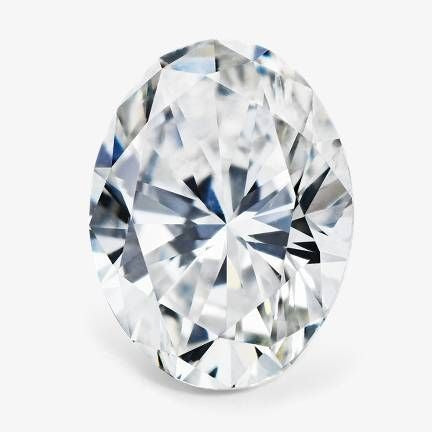
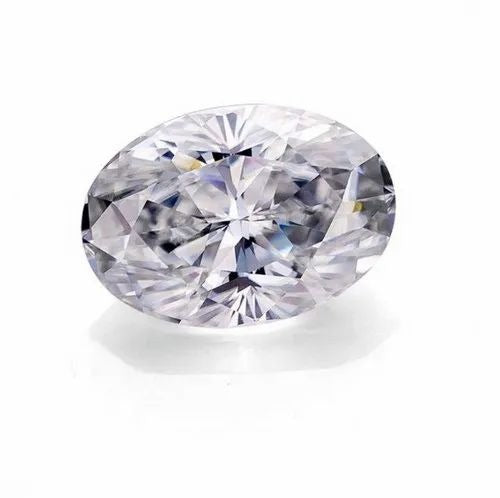
Why the Oval Has Become One of the Most Desired Shapes
The oval brilliant cut was developed in the late 1950s by Russian diamond cutter Lazare Kaplan, who recognized that the round brilliant's optical formula could be adapted to an elongated silhouette without significant loss of light return. The result was a shape that retained approximately 95% of the round's sparkle efficiency while offering a dramatically different visual presence on the hand.
For decades, the oval was a respected but secondary choice — popular among those who wanted something different from the round without venturing into exotic territory. Over the past ten years, that's changed completely. The oval has surged to become the most requested fancy shape in the engagement ring market, driven by its unique combination of size advantage, finger-flattering proportions, and a sparkle character that reads as both classic and contemporary.
The timing of the oval's rise coincides perfectly with moissanite's growing prominence. Moissanite's refractive index of 2.65 and dispersion of 0.104 amplify the oval's modified brilliant faceting beyond what diamond can achieve — producing sweeping flashes of rainbow fire and white brilliance across the stone's elongated surface. The shape that was already the modern buyer's favorite has found its ideal gemstone.
Benefits of Oval Moissanite Stones
The Largest Visual Footprint Per Carat
The oval's elongated profile creates a larger face-up surface area relative to carat weight than a round of the same size. A 1 carat oval measures approximately 7.0mm x 5.0mm compared to a round's 6.5mm diameter — noticeably longer and covering more of the finger's width. This size advantage scales with carat weight, meaning a 2 or 3 carat oval creates genuinely dramatic finger presence that makes the stone appear even more substantial than its carat weight suggests. You get more visual impact per dollar with an oval than with almost any other shape.
The Most Flattering Shape for the Hand
The oval's elongated silhouette creates a visual lengthening effect that makes fingers appear slimmer and longer. This isn't subjective preference — it's basic visual geometry. A vertical shape on a horizontal surface draws the eye along its length, creating the perception of extension. On the finger, this translates into a ring that doesn't just decorate the hand but actively flatters it. It's one of the primary reasons the oval has overtaken the round as the preferred choice for engagement rings among younger buyers.
Sweeping, Cinematic Sparkle
The oval's modified brilliant faceting produces a sparkle character that's distinctly different from the round's. Where the round returns light in uniform, concentric patterns, the oval produces broader, sweeping flashes that move across the stone's elongated surface like waves. The sparkle feels cinematic — dynamic, fluid, and expressive. In moissanite, where each facet returns more fire than diamond, these sweeping flashes become vivid spectral events that catch the eye from across a room.
No Sharp Corners, No Vulnerability
Unlike princess, marquise, or pear shapes, the oval has no pointed tips that require protective setting techniques. Its continuous curved perimeter is inherently durable — there are no vulnerable corners to chip, no special prong configurations needed, and no structural compromises required in any setting style. This makes the oval one of the most practical shapes for daily-wear jewelry, combining beauty with genuine worry-free durability.
Oval Moissanite vs Other Shapes
Understanding how the oval compares to other popular cuts helps clarify whether its particular strengths match your priorities.
Compared to round moissanite, the oval produces approximately 95% of the round's total light return but appears 10–15% larger at the same carat weight. The round delivers more uniform, mathematically optimized sparkle. The oval delivers more finger coverage, more contemporary style, and a more distinctive visual presence. If you want the absolute maximum sparkle regardless of shape, the round wins by a small margin. If you want the best balance of sparkle and visual size, the oval is the stronger choice.
Compared to pear moissanite, the oval shares an elongated profile but maintains bilateral symmetry — both ends are identical, creating balance where the pear introduces directional drama. The pear is more distinctive and more personality-driven. The oval is more versatile and more universally flattering. The pear points. The oval flows. Choose the pear if you want your stone to make a statement. Choose the oval if you want your stone to make everything else look better.
Compared to princess moissanite, the contrast is between curves and angles. The princess is sharp, geometric, and architecturally modern — a square of concentrated brilliance. The oval is soft, elongated, and romantically modern — an ellipse of sweeping fire. The princess appeals to those who think in straight lines and clean edges. The oval appeals to those who think in movement and flow. Neither is objectively superior. They express fundamentally different design philosophies.
Compared to the cushion, the oval shares a curved, cornerless outline but delivers a distinctly different sparkle pattern. The cushion's open facets produce warm, broad flashes with vintage character. The oval's modified brilliant facets produce more focused, more energetic flashes with contemporary character. The cushion whispers warmth. The oval projects elegance. If vintage romance appeals, lean cushion. If modern sophistication appeals, lean oval.
For those ready to see the oval in a finished ring, our oval moissanite engagement rings collection showcases this shape across solitaires, halos, three-stone settings, vintage designs, and pavé bands — demonstrating exactly why the oval has become the defining engagement ring shape of the current generation.
Understanding the Bow-Tie Effect
The bow-tie effect is a dark shadow that appears across the center of some oval stones — a horizontal band where light isn't being returned efficiently. It's caused by facets in the stone's midsection that are angled too steeply or too shallowly to reflect light back to the viewer. In poorly cut ovals, the bow-tie can be pronounced enough to create a visible dark stripe across the middle of the stone.
At Grown Leo, bow-tie evaluation is a primary component of our grading process for oval moissanite. We accept only stones where the bow-tie is minimal to invisible — where light returns consistently across the entire surface without dark interruptions. A well-cut oval should sparkle from tip to tip with no dead zones. Every stone in this collection meets that standard.
This is one of the most important distinctions between buying a loose oval from a quality-focused source versus a mass-market retailer. Many sellers don't evaluate or disclose bow-tie presence. We do — because at Grown Leo, what a stone doesn't show matters as much as what it does.
Available Sizes
This collection spans the full carat range for oval moissanite.
Small calibrated stones (under 0.25 carats, approximately 3.0–4.5mm in length) are available in matched sets for halo accents, cluster designs, and multi-stone compositions. Small ovals add a distinctive elongated accent that differs from the rounds typically used in these applications.
Mid-range stones (0.50–1.50 carats) serve as center stones for engagement rings, pendants, and earring gems. A 1 carat oval measures approximately 7.0mm x 5.0mm — visibly larger than a 1 carat round and carrying more finger presence in any ring setting. This is the most popular size range for custom engagement ring builds, solitaire pendants, and stud earrings.
Large center stones (2.00–3.00+ carats) are where the oval's visual advantages reach their peak. A 2 carat oval measures roughly 9.0mm x 7.0mm. A 3 carat reaches approximately 11.0mm x 8.0mm — a stone that spans virtually the entire width and much of the length of a ring setting with cinematic scale. At these sizes, the oval's elongated presence becomes genuinely striking, and moissanite's fire fills the entire surface with sweeping, dynamic brilliance.
Moissanite vs Diamond in Oval Cut
The oval is one of the shapes where moissanite's superiority over diamond is most persuasive — because the elongated facet pattern creates ideal conditions for moissanite's optical properties to shine.
The oval's modified brilliant facets are distributed across a larger surface area than a round of the same weight. This gives light more entry points, more internal reflection paths, and more exit angles — conditions that favor a stone with a higher refractive index. Moissanite's 2.65 (versus diamond's 2.42) means more light is captured and returned. Its dispersion of 0.104 (versus 0.044) means that returned light carries more vivid spectral color. Across the oval's sweeping surface, these advantages produce broader, more expressive flashes of fire than a diamond oval can achieve.
The cost tells the same story at every size. A loose 1 carat oval diamond of decent quality costs $3,000 to $8,000. A 2 carat runs $8,000 to $22,000. A 3 carat reaches $18,000 to $50,000 or more. Premium loose oval moissanite from Grown Leo costs a fraction of these ranges — with visual performance that matches or exceeds diamond. The oval is the shape where moissanite's combined advantages of superior sparkle and superior value converge most convincingly.
Every stone is lab created — ethically sourced, conflict-free, and produced without mining. The most popular fancy shape in modern jewelry deserves the most responsible modern gemstone.
What You Can Build with Oval Moissanite
The oval's versatility across jewelry categories is one of its strongest practical advantages.
In an engagement ring, the oval is the most popular fancy-shape center stone — and for good reason. A solitaire setting showcases its elongated elegance with nothing to compete. A halo follows the oval outline with a frame of accent rounds that amplifies the perceived size even further. A three-stone design pairs the oval with round or pear side stones for balanced symmetry with variety. A vintage setting adds antique character — milgrain and filigree framing the oval's modern sparkle.
In a pendant, an oval moissanite hangs with vertical elegance — longer than a round, more balanced than a pear, and carrying a presence that flatters virtually every neckline.
In earrings, oval studs offer a more contemporary look than rounds — the elongated shape on the ear reads as deliberately modern. Oval drops add graceful movement below the earlobe. Matched oval pairs are increasingly popular as the demand for non-round earring shapes grows.
For multi-stone pieces — eternity bands, tennis bracelets, and halo accents — calibrated ovals create a flowing, organic sparkle pattern that rounds can't replicate. The elongated stones produce a more fluid visual rhythm that feels natural and modern.
Quality Standards at Grown Leo
The oval demands particular attention to three quality factors that simpler shapes don't require: proportion ratio, symmetry, and bow-tie control.
Proportion ratio determines the oval's character. Ratios between 1.30 and 1.50 are considered the ideal range for most jewelry applications — long enough to express the oval's signature elegance, compact enough to maintain visual weight and sparkle intensity. Ratios below 1.30 approach a round silhouette. Ratios above 1.50 can appear narrow and lose sparkle concentration. We document every stone's exact ratio so you choose the silhouette you want with full transparency.
Symmetry requires that both halves of the oval mirror each other precisely — the curve of the top must match the curve of the bottom, and the widest point must sit exactly at the center. Any deviation produces an unbalanced appearance that no amount of sparkle can correct.
Bow-tie control ensures light returns evenly across the entire stone. We reject ovals with visible bow-tie shadows and accept only stones where brilliance is consistent from end to end.
Every oval moissanite is individually graded across these three factors plus standard cut metrics — facet alignment, polish, color, clarity, and overall light performance. Each stone ships with a certificate of authenticity confirming carat weight, dimensions, proportion ratio, cut grade, and quality specifications. Packaging is designed for secure transit. Every U.S. order ships free with full insurance.