
Total: $0.00
Taxes and shipping calculated at checkout

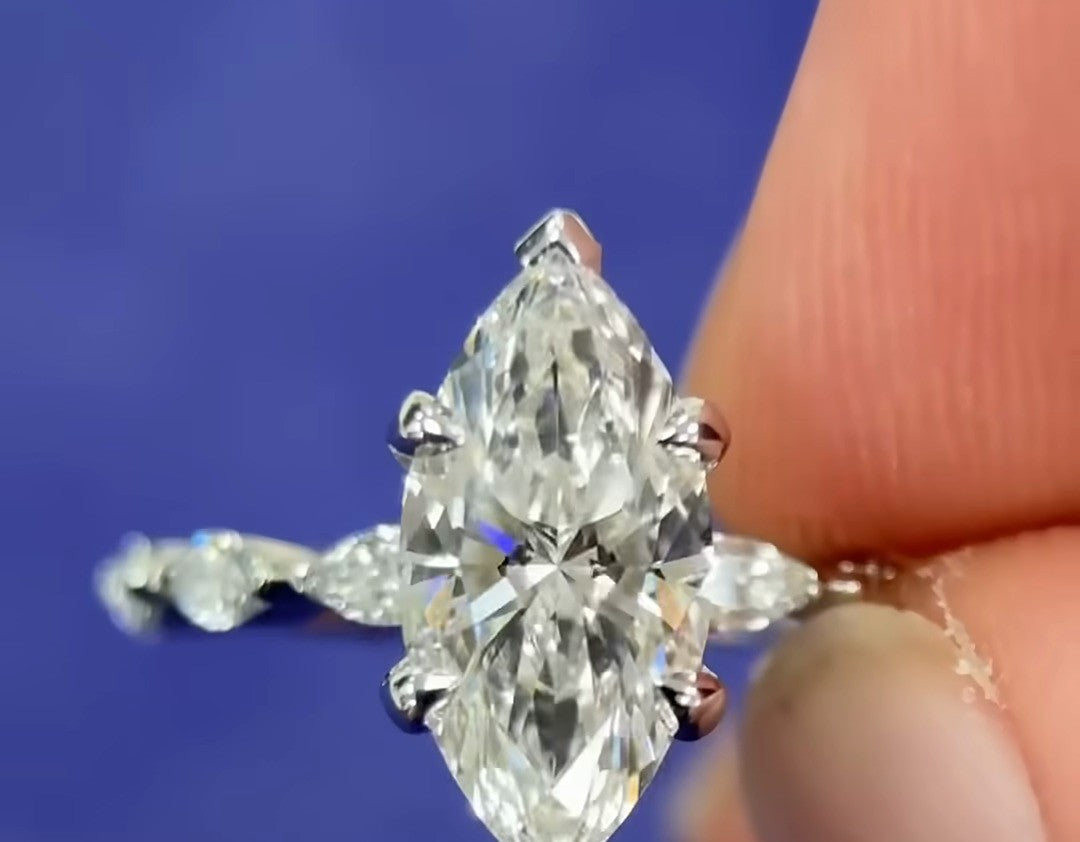
A marquise cut diamond is an elongated brilliant cut with two pointed ends and a curved outline, also known as the navette. Look for a length-to-width ratio near 2:1 (about 1.80 to 2.20), a faint rather than dark bow-tie, matching wings and crisp points, and protect both points with V-prongs, a halo or a bezel. Because it spreads its weight across a long outline, a marquise has more face-up area than any other shape of the same carat weight.
A marquise cut diamond is a boat-shaped brilliant cut with a curved body and a point at each end. GIA groups it with the brilliant-style fancy shapes and notes that it is also called the navette cut. The Diamond Pro translates navette as "small ship" in French, a reference to the hull-like outline. Modern versions typically have 56 or 58 facets.
The popular account is that Louis XV of France commissioned a diamond shaped like the lips of Jeanne Antoinette Poisson, whom he made the Marquise de Pompadour. GIA, the International Gem Society and Wikipedia all present this as a legend rather than documented history. What is documented is the timing: Madame de Pompadour lived from 1721 to 1764 and was the king's official chief mistress from 1745 to 1751, so the name fits 18th-century France. The International Gem Society places the shape's mainstream peak in the late 1960s to early 1970s; graduate gemologist Karen Smith of Oliver Smith Jeweler notes a 1990s wave and a revival today.
A marquise has two points, four wings, one belly and a keel line in place of a culet.
Some cutters add "French tips," several small facets at each end that The Diamond Pro says make the points less prone to chipping.
The classic marquise diamond ratio is about 2:1, and most buyers choose between 1.80 and 2.20. Divide length by width in millimeters: a 5.0 x 2.5 mm stone is 2.00.
| Ratio | Taylor & Hart rating | How it looks |
|---|---|---|
| 1.85 to 2.00 | Excellent | Classic, balanced marquise |
| 1.75 to 1.84 | Very Good | Slightly fuller; a bit sturdier |
| 2.01 to 2.15 | Very Good | Slimmer and more elongated |
| 1.65 to 1.74 or 2.16 to 2.30 | Good | Noticeably chunky, or noticeably thin |
| 1.55 to 1.64 or 2.31 to 2.45 | Fair | Outline starts to look off-shape |
Rare Carat sums it up: above about 2.2 a marquise looks "starved," and below about 1.8 it looks "chubby." For proportions, Taylor & Hart's excellent range is a table of 53% to 63% and a depth of 58% to 62%.
A marquise diamond bow-tie is a dark band across the belly, and almost every marquise has one to some degree. GIA's 2024 study of oval, pear and marquise diamonds found that the elongated outline tends to produce a bow-tie across wide ranges of proportions, and that pavilion main facets running across the belly often strengthen it. Karen Smith attributes a heavy bow-tie to a pavilion cut too deep or too shallow.
GIA's observers disliked bow-ties that are broad, dark or persistent as the stone moves; Du Gemology adds that a slight gray band is not necessarily a problem. In practice:
Outline symmetry matters more in a marquise than in most shapes, because any imbalance is easy to see on a long, narrow stone. GIA recommends Excellent or Very Good symmetry, and the International Gem Society warns that visibly poor symmetry is detrimental to this cut.
GIA reports list polish and symmetry for a marquise but no overall cut grade, while IGI has graded cut on fancy shapes, including marquise, since 2022. GIA's research explains that round-brilliant grading cannot simply be transferred to fancy shapes; a symmetrical marquise alone needs 19 geometric parameters. National Jeweler reports IGI's grade covers nine shapes and combines polish, symmetry, proportions and light return. Either way, have a gemologist review proportions. For grading basics, see our guide to the 4Cs.
A marquise needs a little more care on color than on clarity: it shows body color at the points but hides small inclusions well. Rare Carat notes that color looks darker at the shallow tips and suggests G or better around 1 carat and D to F above 1.5 carats. The Diamond Pro adds that I to K can work in yellow gold.
For clarity, the International Gem Society says SI1 or SI2 can be eye-clean in a marquise, and Rare Carat considers VS2 to SI1 a sensible range. The catch is location. Du Gemology points out that the points have dense facet junctions and that cutters sometimes leave inclusions there because prongs will cover them. Check the plot on the report: an inclusion near a point can weaken the tip, so prefer stones whose inclusions sit away from both ends. Grown Leo's loose marquise lab grown diamonds are IGI certified in D to F color and VVS1 to VS2 clarity with an Excellent cut grade.
A marquise looks larger than any other shape of the same carat weight. The International Gem Society estimates its face-up area is about 15% larger than a round, compared with about 8% for ovals and pears.
| Carat weight | Marquise (mm) | Round (mm) | Oval (mm) |
|---|---|---|---|
| 1 ct | 10.0 x 5.0 | 6.4 | 7.7 x 5.7 |
| 1.5 ct | 11.5 x 5.8 | 2 | 3 |
| 2 ct | 12.5 x 6.3 | 8.1 | 9.7 x 7.2 |
| 3 ct | 14.3 x 7.2 | 4 | 5 |
Measurements are approximate figures from Grown Leo's diamond size chart; individual stones vary with ratio and depth.
The best marquise engagement ring settings cover both points, most often with V-prongs, a halo or a bezel. GIA calls V-prongs essential at each end of a solitaire.

Browse marquise lab grown diamond rings or marquise moissanite engagement rings to compare settings.
A marquise usually pairs best with a contoured band or a deliberate gap, because its points rarely sit flush against a straight band. Bonnie notes that in her experience most brides prefer a flush set, and that contour bands can accommodate a protruding marquise point. Our curved wedding bands are designed for this kind of fit.
A marquise is durable for daily wear, but its points need protection and periodic checks. Rare Carat advises keeping the girdle in the thin to thick range, since an extremely thin girdle at the tips is easier to chip. Have prongs checked about once a year, remove the ring for heavy work, and watch for snagging on clothing, which Bonnie notes is common with long stones.
Choose a marquise for the most length and finger coverage, an oval for a softer look with no points, and a pear for a mix of both.
| Feature | Marquise | Oval | Pear |
|---|---|---|---|
| Typical ratio in the market (GIA) | 1.5 to 2.5 | 1.2 to 1.7 | 1.3 to 1.8 |
| Face-up area vs round (IGS) | About 15% larger | About 8% larger | About 8% larger |
| 1 ct size (Grown Leo chart) | 10.0 x 5.0 mm | 7.7 x 5.7 mm | 8.0 x 5.5 mm |
| Points to protect | Two | None | One |
| Look on the hand | Longest and slimmest | Wider, softer | Teardrop, between the two |
If you like both, the hybrid moval diamond sits between them, and our engagement ring shapes guide compares every option.
Most guides place the ideal marquise diamond ratio near 2:1, meaning the stone is about twice as long as it is wide. Taylor & Hart rates 1.85 to 2.00 as excellent, and gemologists commonly accept 1.80 to 2.20. Below about 1.75 the stone looks wide and chunky; above about 2.20 it starts to look thin. Within that band, pick the outline you prefer.
Nearly all marquise diamonds show some bow-tie, a darker band across the widest part of the stone. GIA research found that the elongated outline tends to create one across wide ranges of proportions. The goal is not zero bow-tie but a faint one that shifts as the stone moves. Avoid a broad, dark bow-tie that stays visible from every angle.
No. GIA reports for marquise and other fancy shapes list polish and symmetry but no overall cut grade, so you judge proportions, outline and bow-tie yourself. IGI added cut grades for nine fancy shapes, including marquise, in 2022. Its system combines proportion ranges, polish, symmetry and a light return assessment, giving buyers one more data point to compare stones.
Yes. The International Gem Society estimates marquise diamonds have about 15% more face-up area than rounds of the same weight, the most of any shape. On Grown Leo's size chart, a 1 carat marquise measures about 10.0 x 5.0 mm, while a 1 carat round measures about 6.4 mm across. The long outline also makes the finger look slimmer.
The two sharp points are the most vulnerable part of a marquise, and GIA notes the shape is more susceptible to chipping. Protect each point with a V-prong, a halo or a bezel, avoid stones with inclusions or a very thin girdle near the tips, and choose a sturdy band. Have a jeweler check the prongs about once a year.


