
Total: $0.00
Taxes and shipping calculated at checkout

A Dutch marquise diamond is an elongated, six-sided diamond: two long straight sides angle inward to a point at each end, so the outline looks like a marquise drawn with straight lines instead of curves. It is also called the elongated hexagon diamond, and many sellers use the two names interchangeably. It is a trade name rather than a lab-defined shape, so grading reports describe it by geometry, for example "Hexagonal Modified Brilliant."
A Dutch marquise is a fancy-shape diamond with a long hexagonal outline and two pointed tips.
Picture a classic marquise and flatten each curved side into two straight planes that meet at the widest point of the stone. You get two tips on the long axis, four angled edges, and a center (often called the belly) that several retailers describe as fuller than a traditional marquise.
No lab, including GIA and IGI, defines "Dutch marquise" as a shape. An IGI report on one such stone listed it as "Hexagonal Modified Brilliant," and other labs may phrase it differently. Shop by measurements and outline, not by the name in a listing.
Usage is split. Jewelry reviewers on YouTube treat "Dutch marquise" and "elongated hexagon" as the same thing. Some retailers draw a line by faceting, calling the brilliant version a Dutch marquise and the step-cut version an elongated hexagon. Others use "elongated hexagon" for wider stones with flatter ends and ratios as low as about 1.2. Always ask for the length, width and a face-up video.
The honest answer is that nobody has documented it. Retailer accounts conflict, and none we reviewed cites a primary historical record, so treat any origin story as unverified.
The Dutch marquise differs from a marquise by its straight sides and from an oval or moval by its pointed tips.
In the Dutch marquise vs marquise decision, both look long for their weight; the choice is mostly curves or corners.
The Dutch marquise cut comes in three main facet patterns, and each one changes how the stone handles light and what grades you need.
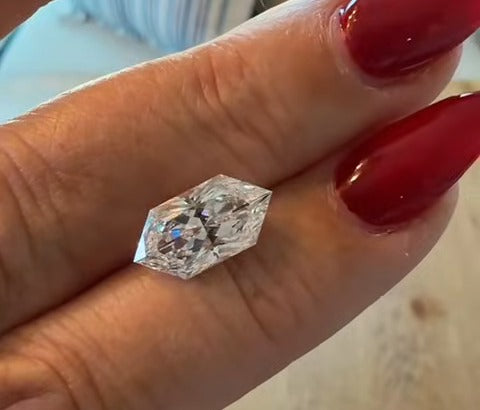
The most common version uses brilliant-style faceting for scintillation. Up close it can read as "crushed ice." At normal viewing distance, the facets through the middle should blend together rather than form a visible seam or dark zone.
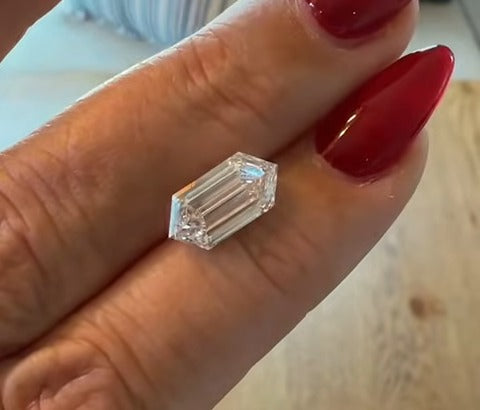
A step-cut version uses parallel facets through the center, giving the broad "hall of mirrors" flashes of an emerald cut, with more brilliant-style facets toward the tips. The open center means inclusions and body color are easier to see.
A criss-cut version uses a crisscrossing facet pattern that one reviewer compares to Asscher-style patterns. It is described as the hardest of the three to find.
Most Dutch marquise diamonds fall between about 1.80 and 2.10, though there is no official range.
The ratio is length divided by width in millimeters. One reviewer considers roughly 2.00 to 2.10 the ideal Dutch marquise look and describes anything above 2.10 as very elongated; one retailer's own inventory ran 1.82 to 2.16 with a median of 2.03. An IGI-graded example measuring 9.49 by 5.15 mm works out to about 1.84. If an inventory has no "Dutch marquise" filter, search "hexagon" and filter for a ratio above about 1.85.
Ratio alone does not tell you everything. With classic marquises, gemologists warn about "fat wings," where extra weight is left near the tips: the ratio looks fine on paper, but the outline looks bulky. The same check applies to the angled edges of a Dutch marquise.
The table below compares the Dutch marquise with the three shapes buyers most often consider alongside it.
| Feature | Dutch marquise | Marquise | Oval | Emerald |
|---|---|---|---|---|
| Outline | Elongated hexagon, straight sides | Curved sides, boat-like | Rounded ends | Rectangle with cut corners |
| Ends | Two points | Two points | No points | Cropped corners |
| Typical L:W ratio | About 1.80 to 2.10 | About 1.80 to 2.20 | About 1.30 to 1.50 | About 1.50 to 1.60 |
| Facet styles | Brilliant, step or criss cut | Brilliant | Brilliant | Step cut |
| Main optical watch-out | Bow-tie (brilliant); visible inclusions (step) | Bow-tie | Bow-tie | Visible inclusions and color |
| Setting priority | Protect both tips | Protect both tips | Standard prongs | Protect corners |
Judge a Dutch marquise mainly on symmetry, the condition of its points, and how evenly light returns across its center.
Brilliant-cut Dutch marquise diamonds hide more than step cuts, so step and criss cut stones deserve higher clarity and color grades.
To compare related elongated shapes, browse our loose marquise cut lab grown diamonds, oval cut lab grown diamonds and emerald cut lab grown diamonds, all IGI certified.
A Dutch marquise engagement ring should protect both pointed tips with V-prongs or a bezel.
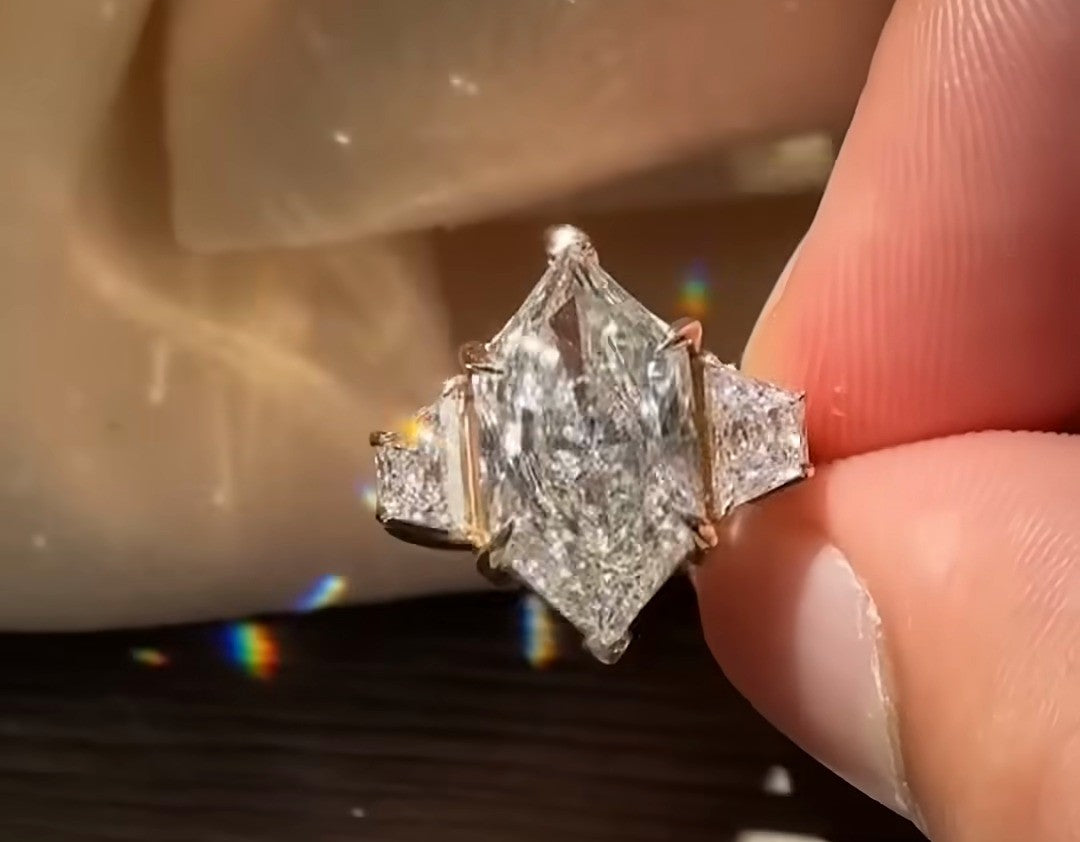
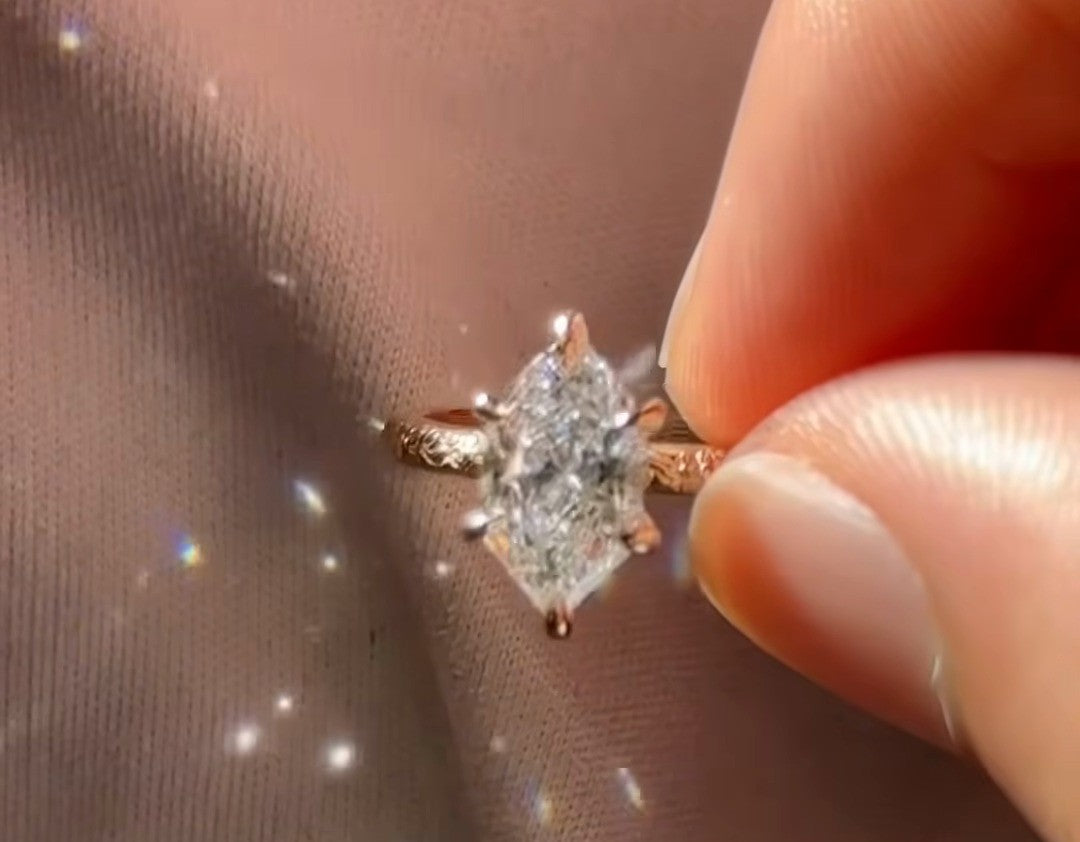
If you like the pointed look but want a proven setting, our marquise lab grown diamond engagement rings use the same tip-protection principles.
The Dutch marquise suits buyers who want an elongated stone with a more geometric, less traditional outline.
It faces up larger than a round of the same weight and lengthens the finger. Slim, longer ratios around 2.00 flatter longer fingers, while shorter fingers may prefer a lower ratio; trying shapes on is the only reliable test. If you are still comparing outlines, our guides to engagement ring shapes and unique diamond cuts lay out the alternatives.
Most Dutch marquise diamonds sold today are lab grown.
The shape spread largely through social media rather than traditional jewelry counters,. Retailers explain that the long six-sided outline wastes more rough than rounds or ovals, so natural cutters rarely produce it without an order, while lab grown producers adapt faster to specialty shapes. Natural examples are scarce and often cut to order. Grown Leo does not currently list a Dutch marquise stone; marquise, oval and emerald are the closest shapes in our loose diamond range.
Often, yes. Many sellers and video reviewers use the two names interchangeably for the same six-sided outline. Usage is not standardized, though. Some retailers reserve "elongated hexagon" for step-cut stones with the same outline, and others use it for wider hexagons with flatter ends. Because neither name appears on a lab report, judge the stone by its measurements, ratio and facet pattern.
A classic marquise has two continuously curved sides that taper to points, like a boat or almond. A Dutch marquise has straight sides that meet at angles, so the outline reads as an elongated hexagon. Both lengthen the finger and have two pointed tips that need protection. The Dutch marquise looks more geometric and is described by several sources as having a fuller center.
There is no official ratio because the Dutch marquise is not a standardized shape. Retailer ranges cluster around 1.80 to 2.10, and one jewelry reviewer calls roughly 2.00 to 2.10 the classic look, with stones above 2.10 reading very elongated. Lower ratios look broader and more like a hexagon. Choose by how the outline looks on your hand rather than by a single number.
A brilliant-cut Dutch marquise can show a bow-tie, the dark band across the center common to elongated brilliants. Some contrast is normal and moves as the stone tilts. Avoid a stone with a fixed, heavy dark band, which points to pavilion angles that are not returning light well. Step-cut versions are more prone to looking glassy or see-through in the center than to a classic bow-tie.
The two pointed tips are the most vulnerable spots and should be covered. V-prongs over each tip are the most common choice, and a full or half bezel protects them with a metal rim. Sources warn against leaving the points exposed in a plain four-prong head. If your outline has defined side corners as well, ask your jeweler whether those need prongs too.
Most Dutch marquise diamonds offered online today are lab grown. Retailer sources explain that the long six-sided outline wastes more rough than rounds or ovals, so natural cutters rarely produce it without an order, while lab grown rough is more readily available. Natural stones exist but are scarce. Always confirm origin on the grading report.


