Total: $0.00
Taxes and shipping calculated at checkout

An oval cut diamond is a modified brilliant with an elliptical outline, and the best ones combine a length-to-width ratio of about 1.35 to 1.50, a depth near 60 to 63 percent, a mild bow-tie and a balanced outline without pointy tips or bulging sides. Because the shape spreads weight across a longer face, an oval looks larger than a round of the same carat weight. Judge it by measurements and video, not by carat weight and certificate grades alone.
Below is what changes an oval's look on the hand, plus a checklist for any stone, whether you shop loose oval lab grown diamonds or a finished ring.
An oval cut diamond is a brilliant-style diamond stretched into an ellipse, with the sparkle of a round and a longer silhouette.
GIA notes that ovals typically pair eight bezel facets with four, six or eight pavilion mains, so similar report numbers can hide different facet patterns. Trade slang adds the flatter-shouldered "moval" (see what a moval diamond is) and the squat, nearly round "roval."
The modern oval brilliant is credited to Lazare Kaplan International, which developed it in 1957.
Nearly as popular as round. The Knot 2026 Real Weddings Study of 10,474 US couples married in 2025 found ovals in 25 percent of engagement rings, just behind round at 26 percent.
The oval diamond ratio is length divided by width, and it sets how slim or full the stone looks face-up.
GIA reports ovals are commonly cut between 1.2 and 1.7; survey respondents preferred narrower shapes near 1.7, but graded stones peaked near 1.4. Lauren B Jewelry says most of its clients choose 1.40 to 1.60, with a trend toward longer ratios for finger coverage.
| Ratio | Face-up look | Who it suits |
|---|---|---|
| Under 1.30 | Wide and soft; can read as a stretched round | Buyers who want a round-like look with a hint of length |
| 1.30 to 1.35 | Slightly elongated, full body | Shorter fingers, halo designs, a vintage feel |
| 1.35 to 1.50 | Classic oval proportions | Most buyers and most hand sizes |
| 1.50 to 1.75 | Long and slender, maximum finger coverage | Long fingers, east-west settings, a modern look |
The oval diamond bow tie is a dark band across the width of the stone, and every oval has one to some degree; the goal is a mild, shifting one.
GIA defines it as dark contrast seen through the table across the stone's width. Elongation causes it, and pavilion mains placed at the belly strengthen it; by 2023 nearly 90 percent of ovals GIA observed had no belly mains. Frank Darling notes large, shallow ovals are most likely to show a strong one.
A good oval has gently rounded ends, smoothly curved sides and two halves that mirror each other.
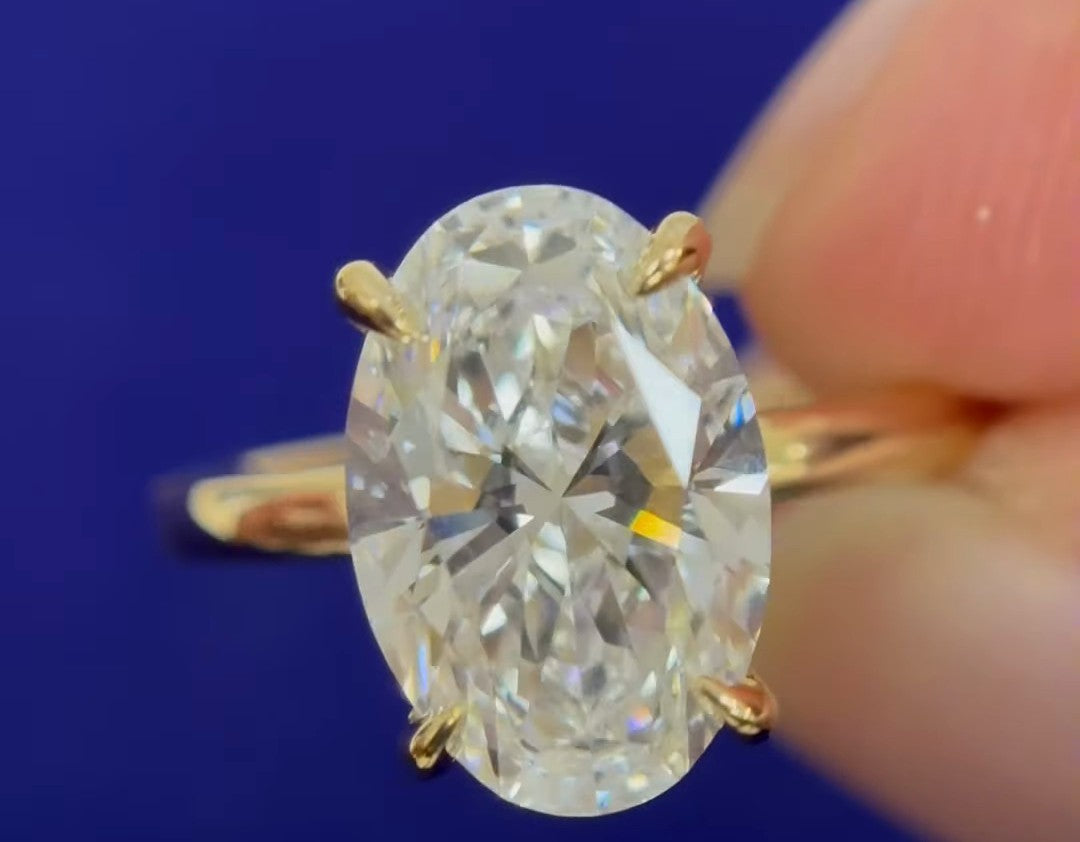
Lab symmetry grades describe facet alignment, not whether the outline is attractive, so an Excellent symmetry grade does not rule out an egg-shaped oval.
Aim for an oval diamond depth of about 60 to 63 percent and a table of about 56 to 60 percent, then confirm with your eyes.
DiamondScreener recommends depth 60 to 63 percent and table 56 to 60 percent. Frank Darling allows 58 to 62 percent depth; Beyond4Cs prefers 62 to 66 percent to soften the bow-tie; Lauren B Jewelry suggests 60 to 65 percent. Common ground: avoid stones under about 58 percent and be cautious above about 64.
Deep ovals hide weight in the pavilion. In a Lauren B Jewelry comparison, two 2 carat ovals measured 10.25 x 7.0 mm and 9.3 x 6.6 mm, and a 1.7 carat at 10.0 x 6.4 mm looked larger than the deep 2 carat. DiamondScreener shows a 1.01 carat at 62.7 percent depth measuring 8.13 x 5.61 mm versus a 1.02 carat at 64.4 percent measuring 7.43 x 5.58 mm. Compare millimeters, not just carats.
GIA does not assign an overall cut grade to oval diamonds, while IGI offers one for ovals and eight other fancy shapes.
A GIA oval report lists polish and symmetry only. IGI added fancy-shape cut grades in 2022, checking polish, symmetry, proportions, shape requirements and light return versus darkness. It does not judge ratio preference. Our loose lab grown diamonds are IGI certified with an Excellent cut grade, and we still recommend checking video.
Prioritize color over clarity in an oval, because its large face-up surface and ends can show tint, while brilliant faceting hides most inclusions.
Frank Darling notes color can show more at the ends than the middle because depth varies across the stone. Lauren B Jewelry advises putting budget into color and accepting lower clarity if the stone is eye-clean and not hazy. Beyond4Cs suggests G or better for an icy look and VS2 or SI1 for eye-clean. Warm gold masks slight tint. Grown Leo loose lab grown diamonds are D to F color, VVS1 to VS2 clarity.
At the same carat weight, an oval is about 20 percent longer than a round's diameter and roughly 5 to 7 percent larger in face-up area.
Figures use typical measurements from our diamond size chart; real stones vary with ratio and depth.
| Carat | Round diameter | Oval (L x W) | Oval area vs round |
|---|---|---|---|
| 1 ct | 6.4 mm | 7.7 x 5.7 mm | About 7% larger |
| 1.5 ct | 7.4 mm | 8.8 x 6.5 mm | About 4% larger |
| 2 ct | 8.1 mm | 9.7 x 7.2 mm | About 6% larger |
| 3 ct | 9.3 mm | 11.1 x 8.2 mm | About 5% larger |
The bigger gain is length along the finger. Price a size with our lab grown diamond price calculator, or see oval vs round moissanite.
Choose an oval for length and coverage, a round for maximum sparkle and simplicity, and an elongated cushion for a softer, chunkier rectangle.
| Feature | Oval | Round | Elongated cushion |
|---|---|---|---|
| Typical ratio | 1.35 to 1.50 | 1.00 | 1.15 to 1.30 |
| Face-up size per carat | Larger than round | Baseline | Larger than round, smaller than oval |
| Bow-tie | Present, varies | None | Possible, usually milder |
| Cut grade on GIA report | No | Yes | No |
| Look on the hand | Lengthening, soft curves | Classic, symmetrical | Pillowy corners, vintage feel |
Cushion ratios and size ranking follow Brilliant Earth.
An oval works in almost any setting, so pick based on how much metal, height and protection you want.

By Bonnie Jewelry advises against very thin bands under large elongated stones, favoring sturdier or cathedral mounts. Browse oval lab grown diamond engagement rings or oval moissanite engagement rings to compare styles.
Plan the engagement ring and wedding band together, because an elongated center stone often leaves a gap against a straight band.
Bonnie of By Bonnie Jewelry says that in her experience 70 to 80 percent of brides prefer a flush-fitting set. Options include a low-profile setting, a contoured band, or accepting a small gap. Our guide on how to match a wedding band walks through each option.
Use this list to check any oval before you buy.
There is no single best ratio, but most buyers choose between 1.35 and 1.50. GIA research found graded ovals cluster near 1.4, while Lauren B Jewelry reports most of its clients pick 1.40 to 1.60. Below about 1.30 the stone starts to read as a stretched round; above 1.50 it looks long and slender. Pick by eye on your hand, then confirm the bow-tie is mild.
No. Some bow-tie is present in virtually every oval because elongation changes how light returns across the stone's width. What you can control is its strength. Avoid very shallow stones, favor depth around 60 to 63 percent, and judge a video that rocks the stone. A good bow-tie is soft and shifts with movement; a bad one is a solid dark band that stays put.
Published guidance ranges from about 58 to 66 percent, but the most common target is roughly 60 to 63 percent. Lauren B Jewelry suggests 60 to 65 percent. Stones much shallower than 58 percent tend to show a strong bow-tie or a washed-out window, while stones above about 64 percent hide weight in the pavilion and face up smaller than their carat weight suggests.
Yes, at the same carat weight. Using our size chart, a 1 carat oval measures about 7.7 x 5.7 mm against 6.4 mm for a round, so it is about 20 percent longer and roughly 7 percent larger in face-up area. The extra length is what most people notice on the finger, especially with a slim band.
No. GIA reports for ovals and other fancy shapes list polish and symmetry but no overall cut grade. IGI began offering cut grades for nine fancy shapes, including ovals, in 2022, based on proportions, shape requirements and light return. Even with a grade, check the outline, measurements and bow-tie in photos or video before you buy.
For a white look in platinum or white gold, many buyers stay in the D to G range. Ovals have a large face-up surface, and color can show more at the ends than in the center because depth varies across the stone. In yellow or rose gold, the warm metal makes slightly lower color less noticeable.


