
Total: $0.00
Taxes and shipping calculated at checkout

A French marquise diamond is a specialty cut with the long, two-pointed length of a marquise but straight, angled sides instead of curved ones, so the outline reads like an elongated octagon with pointed ends. Instead of the many small facets of a brilliant marquise, it uses broad, step-style facets that throw large flashes of light. It is mostly offered as a lab grown specialty cut, and grading reports list its shape simply as "Marquise."
A French marquise is best understood as a hybrid: marquise length and points, emerald-cut style faceting, and straight angled sides.
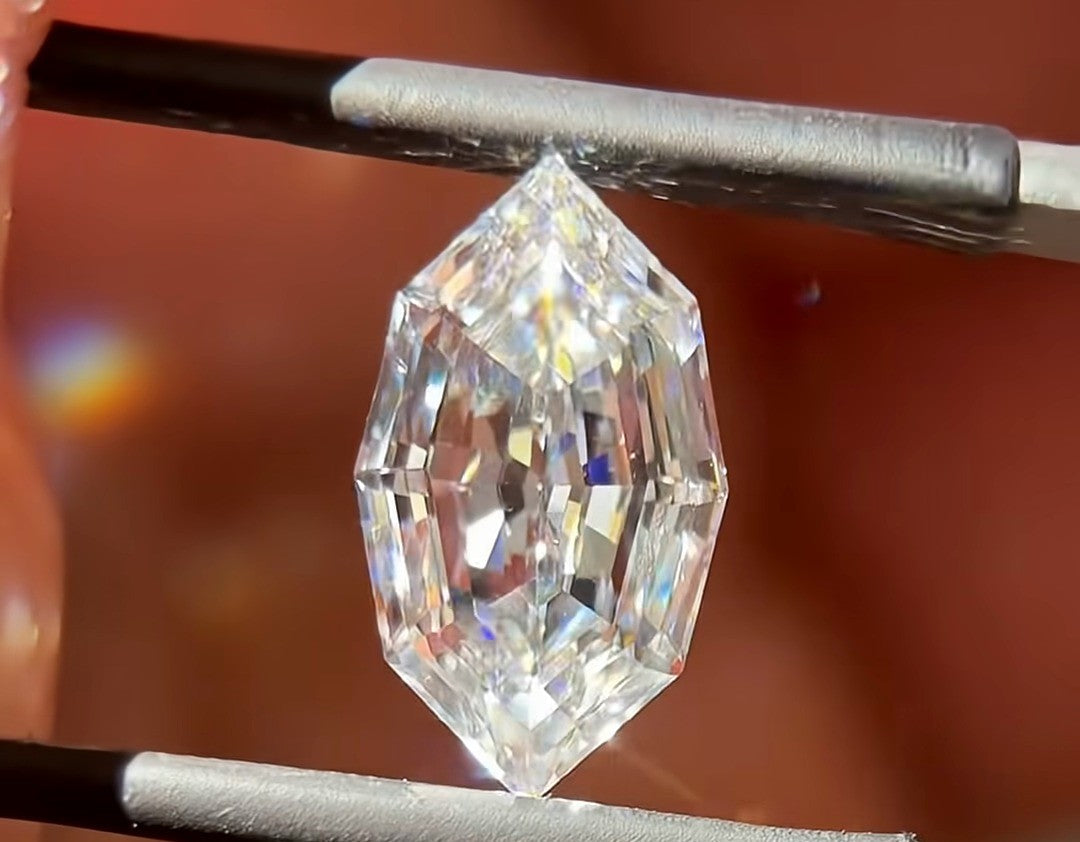
Stienhardt, a lab grown diamond retailer, shows the cut in an Instagram reel titled "French Marquise Cut Diamond" and in a matching YouTube short, where it describes the stone as "essentially a hybrid shape between the emerald cut and the marquise cut." Here is what the footage shows:
The stone in the reel gives a useful real-world reference. It is one example, not a standard.
| Specification | Stone shown in the reel |
|---|---|
| Carat weight | 2.56 ct |
| Color / clarity | D / VS1 |
| Polish / symmetry | Excellent / Excellent |
| Table | 59.0% |
| Depth | 63.9% (4.54 mm) |
| Width | 6.95 mm |
| Length-to-width ratio | 1.65 |
| Shape on report | Marquise |
A 1.65 ratio is on the short, broad end for a marquise-type stone; GIA reports that the classic marquises it grades mostly fall between 1.6:1 and 2.2:1.
Before the specialty cut, "French" in marquise talk usually referred to French tips, a faceting detail on an ordinary curved marquise.
GIA describes French tips as a style that replaces the large bezel facet at each point with smaller star and upper girdle facets, and says this strengthens the tip area. The International Gem Society adds that it makes the points look more star-like. A marquise with French tips keeps its curved navette outline and brilliant faceting, so it is a different stone from the straight-sided French marquise above. Naming is not standardized either: some retail listings use "French Marquise" for a curved marquise with antique-style faceting. If a seller uses the term, ask which one they mean and look at a face-up video.
The word "French" also echoes the marquise's history. GIA recounts the legend that Louis XV commissioned the shape for the Marquise de Pompadour, and that "navette" is Old French for "little ship."
All three are long stones with two pointed ends; the French marquise differs from the classic in outline and faceting, and from the Dutch marquise in number of sides and faceting style.
A classic brilliant marquise usually has 56 or 58 facets, according to the International Gem Society, and is covered in our marquise cut diamond guide. A Dutch marquise, explained in our Dutch marquise diamond guide, has two long straight sides and four short angled edges meeting in points, which Clairamor describes as an elongated hexagon. Clairamor and Stienhardt both note that a step-cut version of that six-sided outline is usually sold as an elongated hexagon diamond.
| Feature | French marquise | Classic marquise | Dutch marquise |
|---|---|---|---|
| Outline | About 8 straight, angled sides ending in two points (elongated octagon) | Smoothly curved sides ending in two points (navette) | 6 straight sides ending in two points (elongated hexagon) |
| Faceting | Broad step-style facets with chevron and criss-cross patterns | Brilliant, usually 56 or 58 facets, large bezel facet at each point | Usually brilliant; the step-cut version is often sold as an elongated hexagon |
| Typical look | Large flashes mixed with sparkle; geometric, emerald-like character | Fine, scattered brilliance; soft, curved silhouette | Angular outline with brilliant sparkle |
| Report shape name | "Marquise" (as on the stone Stienhardt shows) | Marquise | Described by geometry, for example "Hexagonal Modified Brilliant" on IGI reports |
| Ratio notes | No published standard; the stone Stienhardt shows is 1.65 | GIA: most between 1.6:1 and 2.2:1, 2:1 trade preference | About 2.00 to 2.10 favored by one seller; its stock ran 1.82 to 2.16 |
Inspect a French marquise the way you would an emerald cut, then add the point checks every marquise needs.
GIA does not grade the overall proportions of fancy-shaped diamonds; its reports assess polish and symmetry instead, and it notes that step cuts call for higher clarity because inclusions can be easier to see through broad facets. That makes video your main tool. Here is the checklist I use as a gemologist for a step-faceted, pointed stone:
Every pointed stone needs its tips covered, and a French marquise is no exception.
GIA recommends V-prongs that wrap each point of a marquise, or a six-prong head with V-prongs on the tips; a bezel covers both points and is less likely to snag. Michael Gabriels treats a Medium girdle at the tips as the practical minimum for daily wear. JewelryTalk suggests French tips as an extra safeguard if you will not use V-prongs, but on a straight-sided French marquise the V-prong remains the main protection. The same advice applies to marquise moissanite engagement rings: moissanite is 9.25 on the Mohs scale, and any pointed stone is safer with covered tips.
A French marquise engagement ring suits someone who loves the marquise's length and points but wants the crisp, mirror-like flash of an emerald cut.
Its straight sides give a more architectural look than a curved marquise, and its broader step facets show bigger, slower flashes. Buyers who want maximum fine sparkle may prefer a classic brilliant marquise, while fans of a cleaner six-sided outline should compare the Dutch marquise. If you are still choosing a shape, our engagement ring shapes guide sets the marquise family against the alternatives.
French marquise diamonds are a niche specialty cut, offered mainly by lab grown retailers, and the report will only say "Marquise."
That means you have to identify the cut from images, not paperwork. Grown Leo's loose marquise lab grown diamonds are IGI certified, 1 to 10 carats, D to F color, VVS1 to VS2 clarity and Excellent cut; they are standard marquises, not stones sold as French marquises. Finished designs are in our marquise lab grown diamond rings.
A French marquise diamond is a specialty cut with the long, two-pointed length of a marquise but straight, angled sides instead of curves, giving an elongated octagon with pointed ends. It uses broad, step-style facets, which Stienhardt calls a hybrid of the emerald cut and the marquise cut. It is mostly offered in lab grown diamonds, and grading reports list the shape simply as Marquise.
The difference is the outline. A Dutch marquise is an elongated hexagon: two long straight sides and four short angled edges meeting in two points, usually with brilliant faceting. A French marquise breaks the outline into more straight, angled sides, so it reads closer to an elongated octagon with pointed tips, and it uses broad step-style facets that give larger flashes.
A classic marquise has smoothly curved sides and brilliant faceting, usually 56 or 58 facets with a large bezel facet at each point, built for scattered sparkle. A French marquise keeps the length and two points but replaces the curves with straight, angled sides and uses broad step-style facets with chevron patterns, so it shows bigger flashes of light mixed with sparkle.
Do not expect it to. The French marquise shown by Stienhardt, a 2.56 carat D color, VS1 stone, has a lab report that lists the shape only as Marquise. Because the report name will not tell you which cut you are getting, confirm the straight-sided outline and step faceting from a face-up photo or video, and use the measurements to work out the length-to-width ratio.
There is no published standard yet. The French marquise in Stienhardt's video measures 1.65 length to width, which is one example, not a rule. For classic marquises, GIA reports most stones it grades fall between 1.6:1 and 2.2:1, with 2:1 the trade preference. Lower ratios look broader; higher ratios look slimmer. Choose by photos and how the stone looks on the hand.
Grown Leo sells standard marquise lab grown diamonds, IGI certified, 1 to 10 carats, D to F color, VVS1 to VS2 clarity, with an Excellent cut grade, plus marquise moissanite engagement rings. We do not currently list a stone marketed as a French marquise. If you want this cut, ask for face-up video of a specific stone to confirm the straight sides and step faceting.


