
Total: $0.00
Taxes and shipping calculated at checkout

An elongated hexagon diamond is a six-sided diamond stretched along its length, usually with two long parallel sides and four shorter angled edges. The terms elongated hexagon and Dutch marquise are often used interchangeably, but a Dutch marquise is specifically a slender elongated hexagon with pointed ends, around 1.85 to 2.1 in the listings and reviews we checked. Elongated hexagon is the broader term: it also covers wider stones (roughly 1.2 to 1.6) and flat-ended, step-cut versions, so every Dutch marquise is an elongated hexagon, but not every elongated hexagon is a Dutch marquise.
An elongated hexagon diamond is a hexagon whose length exceeds its width, as opposed to a regular hexagon with roughly equal length and width.
"Hexagon" describes an outline, not a standardized cut, as Stienhardt puts it. Within that outline you will find three broad groups:
Usage is not consistent. Some reviewers treat Dutch marquise and elongated hexagon as one shape. Stienhardt sells its elongated hexagon as a step cut and its Dutch marquise as a brilliant, separating them by flat versus pointed ends. Carat Diamonds separates them by ratio, about 1.2 to 1.5 for the elongated hexagon versus 1.6 to 2.0 for the Dutch marquise. No lab defines either name, so read the measurements and look at the ends.
The practical difference in the hexagon vs Dutch marquise choice is width and tip shape: the hexagon is broader with blunt ends, while the Dutch marquise is slimmer with two points.
Carat Diamonds notes that a 1 carat Dutch marquise typically looks noticeably larger face-up than a 1 carat hexagon, because its weight is spread along more of the finger. Brilliant Earth adds that above about 1.40 the parallel sides dominate and the stone reads as a distinctly rectangular hexagon.
The jewelry reviewer Tam suggests that if a retailer has no Dutch marquise filter, you search "hexagon" and filter for ratios above about 1.85 to find the slender look. For the slender version with pointed tips, see our Dutch marquise diamond guide, which covers its ratios and tip protection in depth.
The table below compares the regular hexagon, elongated hexagon, Dutch marquise and emerald cut on the points that matter when choosing.
| Feature | Regular hexagon | Elongated hexagon | Dutch marquise | Emerald cut |
|---|---|---|---|---|
| Outline | Six roughly equal sides | Two long parallel sides, four shorter angled edges | Long six-sided outline tapering to two points | Rectangle with cut corners |
| Typical L:W ratio | About 1:1 | About 1.15 to 1.60 (most guides 1.2 to 1.5) | About 1.85 to 2.1 (one retailer says 1.6 to 2.0) | About 1.30 to 1.75 |
| Ends | Corners all around | Flat edge or blunt corner | Pointed tips | Cropped corners |
| Common faceting | Step, brilliant or rose | Step, brilliant or rose | Mostly brilliant; step and criss cut exist | Step |
| Main watch-out | Six corners to protect | Windowing and visible inclusions in step cuts | Exposed tips; bow-tie in brilliants | Windowing and visible inclusions |
| Typical protection | Six prongs or bezel | Six corner prongs, bezel or partial bezel | V-prongs or bezel on the tips | Corner prongs or bezel |
Hexagons come in three faceting styles, and the step cut hexagon is described by several sources as the most common.
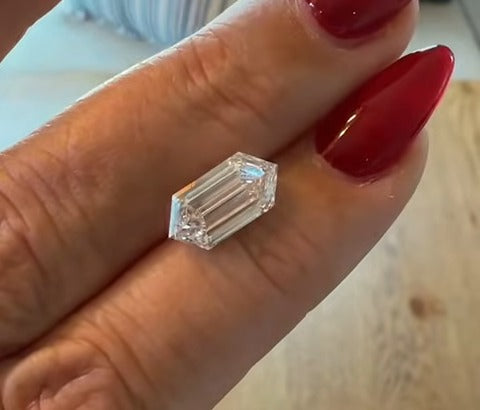
A step cut uses long, parallel facets in tiers, like an emerald or Asscher cut, producing the "hall of mirrors": broad, calm flashes rather than pinpoint sparkle. VRAI cuts all of its hexagons as step cuts, saying brilliant faceting has not been fully refined for this outline.
A brilliant hexagon uses many small triangular and kite-shaped facets for more scintillation and better concealment of small inclusions. Ken & Dana Design notes it is harder to find.
A rose cut has a flat base and a domed top covered in triangular facets. It faces up large but has little sparkle. In her video on hexagon cut rings, Abby Sparks shows rose-cut and rough-style hexagons and notes they often show visible color and inclusions.
The two cut problems to check in a step cut hexagon are windowing, a see-through center, and extinction, dark areas that never brighten.
Neither shows up reliably on paper, and most fancy shapes carry no overall lab cut grade, so judge the actual stone with this checklist:
A step cut hexagon needs higher clarity and color than a brilliant hexagon because its open facets show both more readily.
Stop upgrading once the stone is eye-clean on video. Our guide to the 4Cs explains the grades.
Grading labs describe a hexagon's geometry, so the report may never say "elongated hexagon" or "Dutch marquise."
Mavilo notes reports may use terms like "hexagonal step cut" or "modified hexagonal brilliant," and Stienhardt cites an IGI report on a Dutch marquise reading "Hexagonal Modified Brilliant." Check the faceting description against the video and verify the report number on the lab's website.
Every hexagon has six corners, and those corners are where chips start, though sources disagree on how exposed an elongated hexagon really is.
VRAI warns that the shape "has numerous sharp corners" and recommends a secure setting for active lifestyles. Carat Diamonds argues the opposite for wider stones: because an elongated hexagon has angled corners instead of acute tips, it is less exposed than a Dutch marquise. Some hexagons are cut with softened or truncated corners, per Rosec Jewels, and any diamond can chip from a sharp knock on an unprotected corner. Mavilo recommends having the setting checked every six to twelve months.
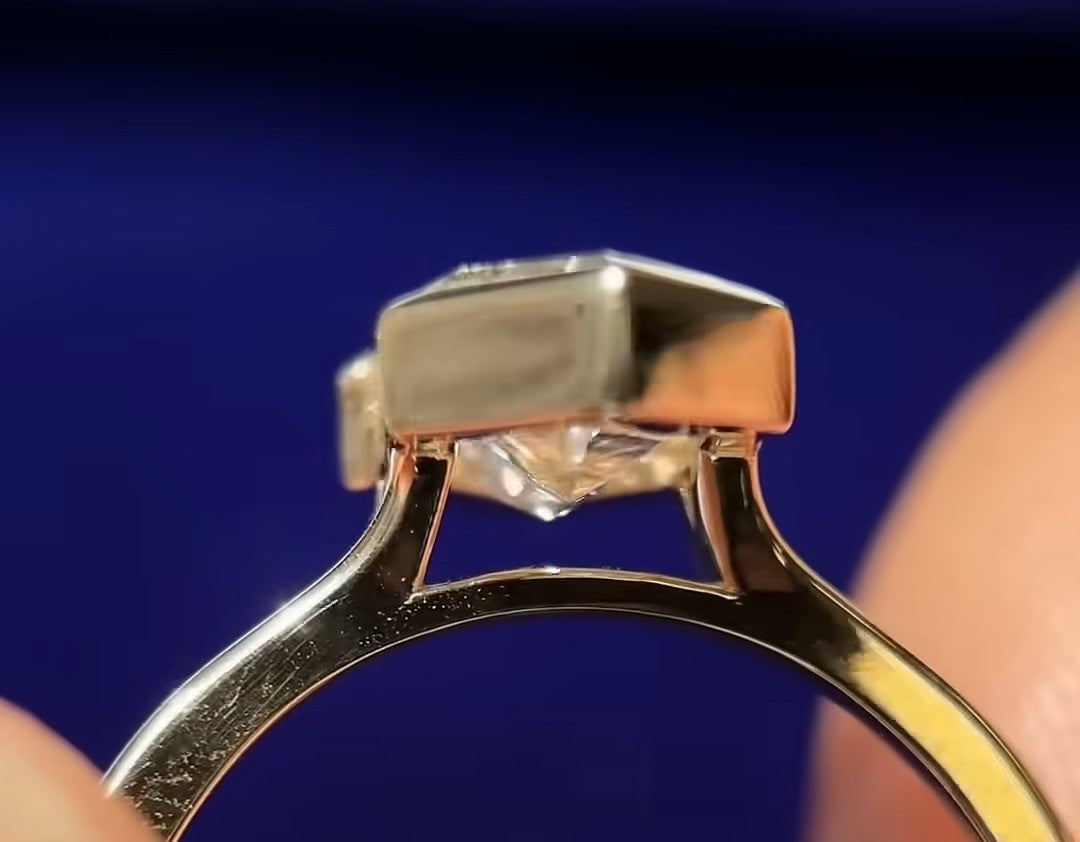
The safest elongated hexagon engagement ring settings are a bezel or six prongs placed on the corners.
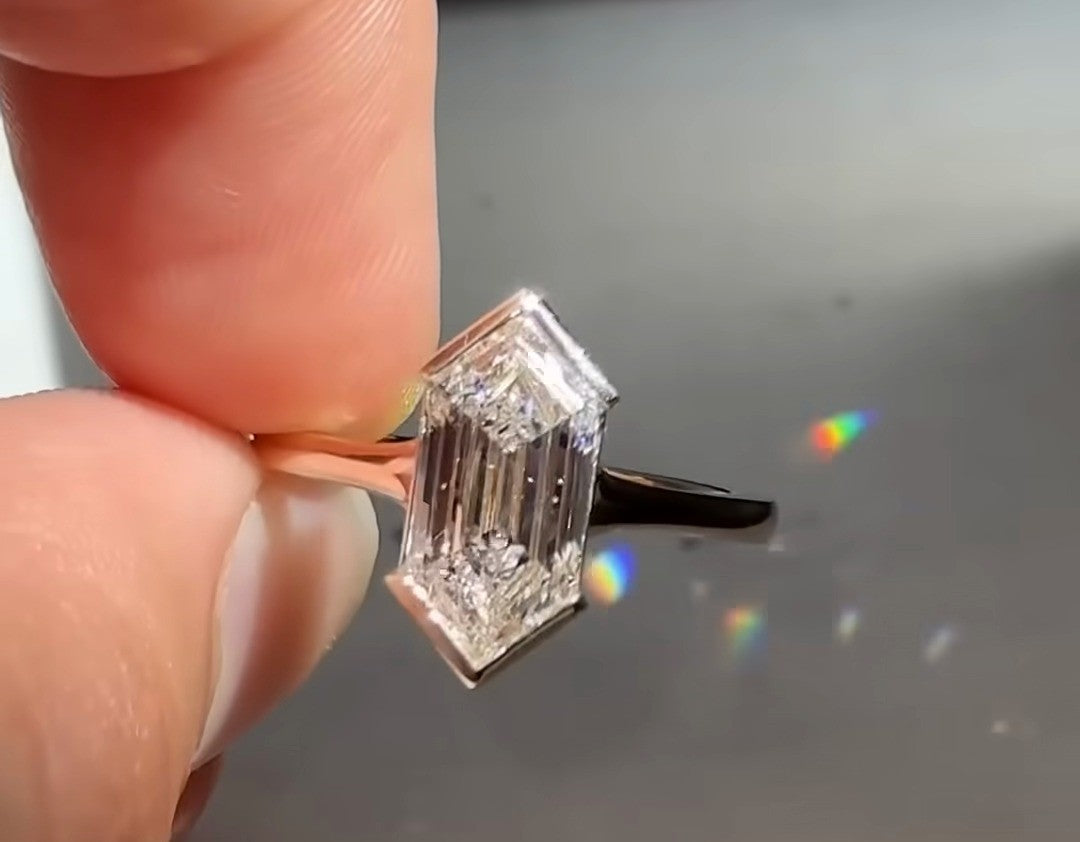
An elongated hexagon suits buyers who want a geometric stone that looks longer than a regular hexagon without the slim, pointed profile of a Dutch marquise.
It is still a specialty shape; Jewelry Shopping Guide notes most diamond retailers do not stock hexagons. Grown Leo does not currently offer a hexagon stone. If you like step-cut mirrors, our emerald cut lab grown diamonds are the closest shape in our IGI-certified range, and our diamond size chart helps you compare face-up dimensions by shape.
Often the terms are used interchangeably, but they are not identical. A Dutch marquise is a slender elongated hexagon with pointed ends, usually around 1.85 to 2.1 in the listings and reviews we checked. Elongated hexagon is the broader term that also covers wider, flat-ended and step-cut stones, roughly 1.2 to 1.6. Every Dutch marquise is an elongated hexagon, but not every elongated hexagon is a Dutch marquise.
There is no industry standard. Brilliant Earth groups elongated hexagons from 1.15 to 1.60 and calls 1.25 to 1.35 a strong general range, with about 1.30 balancing length and geometry. Antique Cut suggests about 1.25 to 1.40, and other retailers give 1.2 to 1.5. Higher ratios look more rectangular; above roughly 1.85 with pointed ends, sellers usually switch to the Dutch marquise name.
Neither is objectively better; they are different looks. A step cut hexagon shows broad, mirror-like flashes, the hall of mirrors effect, but reveals inclusions and body color more easily. A brilliant hexagon gives busier sparkle and hides small inclusions better, though VRAI notes brilliant faceting has not been fully refined for this outline. If you choose the step cut, buy higher clarity and color.
Because the open table shows inclusions, retailers recommend roughly VS2 to VS1 or better for step cut hexagons, while an eye-clean SI1 may work in a brilliant version. For color, one guide suggests G to H in white gold or platinum and H to I in yellow or rose gold. Step faceting emphasizes color, so stay at the higher end if you want a crisp white look.
A bezel or six prongs, one on each corner, are the most commonly recommended settings because they cover the vulnerable corners. Prongs should sit where two straight sides meet, not mid-edge. East-west settings, three-stone designs and halos also work. A halo adds sparkle but does not secure the corners by itself, so the center still needs its own prongs or bezel.
Labs describe geometry rather than trade names, so a report may never say elongated hexagon or Dutch marquise. Shape descriptions such as hexagonal step cut, modified hexagonal brilliant or hexagonal modified brilliant appear on reports, depending on the lab and faceting. Most fancy shapes carry no overall cut grade, so rely on the measurements, proportions, polish and symmetry plus a video of the actual stone.


