
Total: $0.00
Taxes and shipping calculated at checkout

An elongated cushion cut diamond is a cushion with a rectangular outline, usually a length-to-width ratio of about 1.10 to 1.15 or higher, instead of the near-square 1.00 to 1.05 of a classic cushion. It keeps the rounded corners and gently curved sides that give cushions their pillow shape, but it covers more of the finger lengthwise. The details that matter most are the ratio, the facet style (chunky or crushed ice), color in the corners, and a symmetrical outline.
An elongated cushion is a cushion cut stretched into a rectangle while keeping its soft corners and curved sides.
Blue Nile defines an elongated cushion as one with a length-to-width ratio of 1.10 or greater and says most fall between 1.10 and 1.60. Brian Gavin uses a slightly stricter cutoff of 1.15. Taylor and Hart's video guide notes the longer ratios lengthen the look of the finger.
Longer cushions are harder to find. Blue Nile describes elongated cushions as rarer than square ones, and Taylor and Hart says stones above 1.15 are more scarce.
The cushion descends from the old mine cut, a hand-cut squarish brilliant that dominated diamond cutting before the modern round.
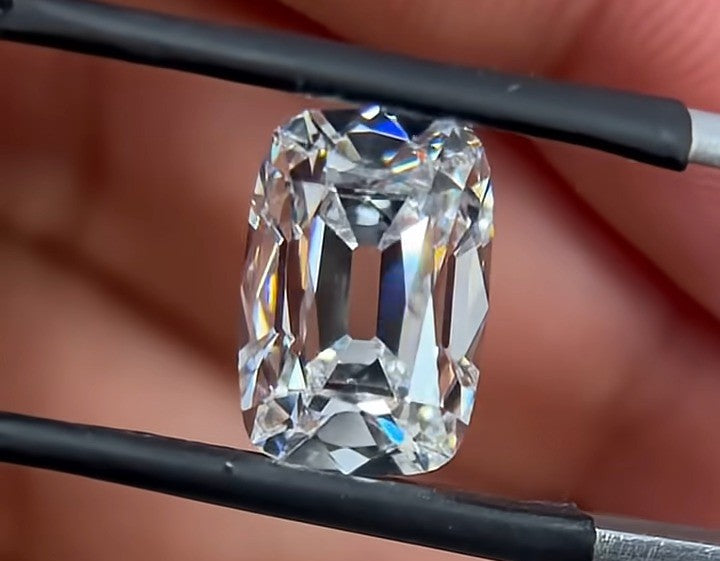
According to GIA, the old mine cut dates to the 1700s and was the most common cut until the late 19th century. The name refers to the Brazilian mines, which became known as the "old mines" after diamonds were discovered in South Africa. GIA describes them as squarish, with a high crown, small table and deep pavilion. For more on the antique version, see our old mine cut diamond guide.
Cushions come in two broad looks, chunky (antique-style, with defined facets) and crushed ice (many small, scattered sparkles), and the grading report name does not reliably tell you which one you are getting.
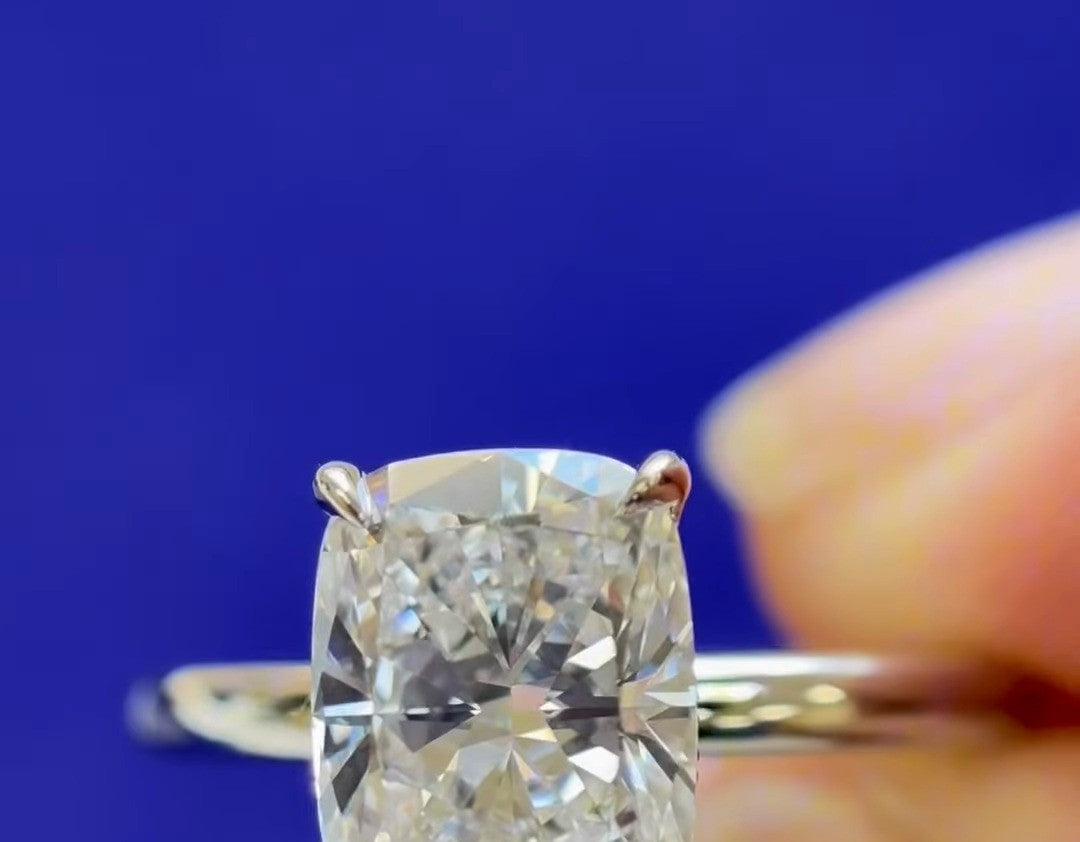
GIA reports list a cushion as either "cushion brilliant" or "cushion modified brilliant," depending on the pavilion facet arrangement. GIA notes that cushions typically have four or eight pavilion mains, and that added crown or pavilion facets make the stone a modified cushion brilliant. Taylor and Hart's video notes that most reports classify cushions as cushion modified brilliant, and Petra Gems estimates the modified style makes up about 98 percent of cushions cut.
The Diamond Pro found "absolutely no correlation" between the report label and the visible style in its own examples, and Petra Gems states that nothing on the certificate tells you whether a cushion looks crushed ice or star-like. Buy from a video, not the report alone.
Two elongated cushions with the same ratio can look quite different because of how curved their sides are and how rounded their corners are.
Taylor and Hart's video points out that some cushions have more convex, pillowy sides while others have flatter sides with only a slight curve. Corner roundness also varies, and The Diamond Pro notes that the report will not tell you how rounded the corners are. GIA's buying tip applies here: the sides and corners should mirror each other in the amount of curve.
For a clearly elongated cushion, look for a length-to-width ratio between about 1.15 and 1.30, with 1.30 to 1.50 for a bolder rectangle.
| Ratio (L/W) | Appearance | Notes |
|---|---|---|
| 1.00 to 1.05 | Square (traditional cushion) | Classic pillow shape |
| 1.05 to 1.10 | Neither clearly square nor rectangular | Diamond Screener calls this a middle zone |
| 1.10 to 1.15 | Slightly elongated | Subtle lengthening |
| 1.15 to 1.30 | Classic elongated | The range most guides recommend |
| 1.30 to 1.50 | Dramatically elongated | Stronger rectangle, more finger coverage |
| Above 1.50 | Very slim | May look narrow; rarer |
Tiers come from Brilliant Earth and Brian Gavin; Brilliant Earth names 1.15 to 1.25 the engagement ring sweet spot. Melanie Casey Jewelry calls ratio the most important consideration and prefers 1.2 or longer, since a near-square stone loses the finger-lengthening effect.
Because GIA does not give cushions a cut grade, you have to judge an elongated cushion from its proportions, finish grades and a video.
Grown Leo's loose cushion cut lab grown diamonds are IGI certified, Excellent cut, D to F color, from 1 to 10 carats.
Choose color more carefully than clarity, because cushions show body color easily but hide inclusions fairly well.
The Diamond Pro calls cushions one of the worst shapes for retaining color, and Mavilo notes that in elongated and crushed ice cushions color often concentrates toward the corners and ends. Melanie Casey Jewelry suggests G or higher for natural stones and F or higher for lab grown, since the larger surface shows color a bit more. Petra Gems says a crushed ice stone needs G or higher to look as white as a chunky one at a lower grade.
Clarity is more forgiving. Taylor and Hart's video says the cushion shape tends to hide inclusions better than many shapes, and Melanie Casey Jewelry finds VS2 natural or VS1 lab grown usually eye-clean. The Diamond Pro calls crushed ice faceting a very good hider of inclusions.
An elongated cushion looks larger on the hand than a square cushion of the same weight, but usually a bit smaller than an oval or elongated radiant.
Brian Gavin explains that elongation spreads the same weight over a longer outline. Brilliant Earth ranks cushions behind ovals and radiants in visual size at equal weight, since cushions are often cut deeper. The typical dimensions below come from Grown Leo's diamond size chart and on-hand simulator; it lists square cushions only, so use it as a reference point.
| Carat | Square cushion (mm) | Oval (mm) | Radiant (mm) |
|---|---|---|---|
| 1 ct | 6.0 | 7.7 x 5.7 | 7.0 x 5.5 |
| 1.5 ct | 6.9 | 8.8 x 6.5 | 8.0 x 6.3 |
| 2 ct | 7.5 | 9.7 x 7.2 | 8.8 x 6.9 |
| 3 ct | 8.6 | 11.1 x 8.2 | 10.0 x 7.8 |
An elongated cushion trades some width for length versus the square figure, so compare the millimeter measurements on the report.
Four corner prongs are the classic choice, while six prongs, double claws or a bezel add security for daily wear.

Browse cushion lab grown diamond engagement rings or cushion moissanite engagement rings, and see cushion stud earrings for the same shape in earrings.
Pick the elongated cushion for soft corners and a vintage feel, the oval for maximum face-up size, and the radiant for crisp corners and crushed ice sparkle.
| Feature | Elongated cushion | Oval | Elongated radiant |
|---|---|---|---|
| Corners | Rounded | None (curved outline) | Cropped, straight |
| Typical ratio | 1.15 to 1.30 | 1.33 to 1.66 (GIA) | 1.20 to 1.40 |
| Sparkle | Chunky or crushed ice | Brilliant faceting | Crushed ice, 70 facets |
| Bow-tie | Generally not a concern | Common concern | Can occur; check video before buying |
| Hides inclusions | Moderate | Well | High |
| Face-up size | Slightly smaller | Larger | Larger |
Data come from Brilliant Earth, Blue Nile and GIA. For a deeper look at the square and elongated versions, read our radiant cut vs cushion cut guide and our cushion vs round diamond comparison.
An elongated cushion cut diamond is a cushion with a rectangular outline instead of a square one. Blue Nile defines it as a cushion with a length-to-width ratio of 1.10 or greater, while Brian Gavin sets the threshold at 1.15. It keeps the rounded corners and softly curved sides of a classic cushion but covers more of the finger lengthwise.
Most guides put the elongated cushion sweet spot between about 1.15 and 1.30. Brilliant Earth recommends 1.15 to 1.25 for balanced proportions, and Taylor and Hart suggests 1.15 to 1.40 for a clearly elongated look. Below about 1.10 the stone tends to read as square, and above about 1.50 it can start to look narrow.
Both are GIA shape names based on the pavilion facet arrangement. A cushion brilliant usually has eight pavilion main facets and larger, more defined flashes. A cushion modified brilliant adds or alters facets and is far more common. The label does not reliably tell you the look, because some modified brilliants still show a chunky pattern, so judge the stone from a video.
Yes, at the same carat weight an elongated cushion usually looks larger on the hand than a square one, because the weight is spread over a longer outline that covers more of the finger. It still tends to face up a little smaller than an oval or elongated radiant of the same weight, since cushions are often cut deeper. Compare millimeter measurements, not just carats.
Cushions show body color more than most shapes, and it tends to gather at the corners and ends. Designer Melanie Casey suggests F or higher for lab grown stones. Clarity is more forgiving: VS2 to VS1 is usually eye-clean in a cushion, and crushed ice faceting hides small inclusions well. Always check a video or photo for eye-cleanliness.


