
Total: $0.00
Taxes and shipping calculated at checkout

A radiant cut diamond is a square or rectangular diamond with cropped corners and brilliant faceting, designed by Henry Grossbard in 1977 to combine the outline of an emerald cut with the sparkle of a round. For most buyers, a good radiant has a length-to-width ratio near 1.00 to 1.05 (square) or about 1.15 to 1.35 (elongated), a depth of roughly 61 to 67%, a balanced bow tie and clean corners. A buying checklist closes the guide.
A radiant cut is a cut-cornered square or rectangle faceted like a brilliant, so it sparkles like a round while keeping straight, geometric sides.
GIA describes the radiant as combining "the sleek, geometric lines of an emerald cut" with brilliant-cut sparkle, and notes that its 70 facets make it one of the most brilliant rectangular shapes, often said to have a crushed ice appearance. Grading reports usually call it a cut-cornered rectangular or square modified brilliant.
The radiant cut was designed in 1977 by Henry Grossbard, a New York diamond cutter, which makes it one of the newest classic diamond shapes.
The Diamond Pro and 77 Diamonds both credit Grossbard, of the Radiant Cut Diamond Company, with the design, and the International Gem Society calls it the most modern diamond shape. He combined the emerald cut outline with round brilliant faceting.
The radiant diamond ratio (length divided by width) decides whether the stone reads as a square radiant or an elongated radiant, and there is no single correct number.
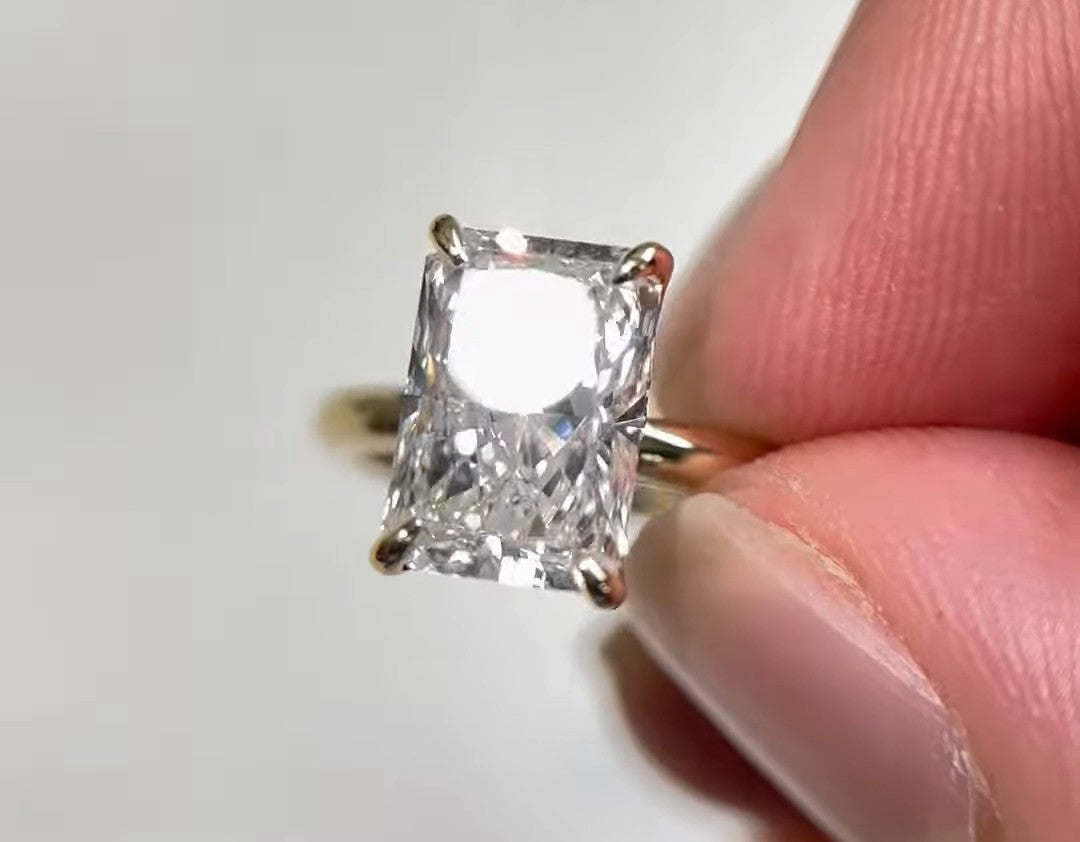
Divide length by width in millimeters: a 7.0 x 5.5 mm stone is about 1.27.
| Look | The Diamond Pro (excellent) | International Gem Society | 77 Diamonds |
|---|---|---|---|
| Square radiant | 1.00 to 1.03 (1.04 to 1.05 very good) | Under 1.05 | 1.00 to 1.05 |
| Elongated radiant | 1.20 to 1.30 (1.15 to 1.19 or 1.31 to 1.35 very good) | 1.15 to 1.35 | Over 1.05 up to 1.50 |
GIA notes that a rectangular radiant lengthens the finger, while a square radiant looks compact and symmetrical.
Look for a depth of about 61 to 67% and a table of about 61 to 69%, the range both the International Gem Society and The Diamond Pro recommend.
| Measurement | Best range | Wider, budget range | Source |
|---|---|---|---|
| Depth % | 61 to 67% | 59 to 70% | International Gem Society |
| Table % | 61 to 69% | 58 to 71% | International Gem Society |
| Table % (very good) | 61 to 69% excellent | 57 to 60% or 70 to 72% | The Diamond Pro |
Numbers narrow the field, but they do not show how a radiant performs, which is why the bow tie check matters.
A bow tie is a dark band across the center of an elongated radiant, and you can only judge it by looking at the stone, not the report.
The International Gem Society groups radiants with ovals, pears and marquises as shapes that have a bow tie region, and says a radiant with a large bow tie that does not sparkle is not worth the money. TeachJewelry notes bow ties are not listed on grading reports.
Cropped corners make a radiant more chip resistant than a princess cut because they remove the thin, pointed tips that take the hardest knocks.
The Diamond Pro notes that the beveled corners make radiant engagement rings less likely to chip, and the International Gem Society contrasts them with a princess cut's sharp corners, which are more likely to snag and chip. The Diamond Pro advises checking that all four corners are even and neither too wide nor too narrow.
Radiants show color a little more than rounds, especially at the ends of elongated stones, so match the color grade to your metal.
Grown Leo's loose radiant cut lab grown diamonds are IGI certified in D to F color, so tint at the ends is not a concern for those stones.
Radiants hide inclusions better than step cuts like the emerald, so you can usually go lower in clarity, as long as nothing sits near a corner or under the table.
GIA says the radiant's facet pattern helps mask inclusions. The International Gem Society's written guide says eye-clean stones can be found in SI1 and SI2, with VS2 worth considering at 2 carats and up; its video suggests VS2 to SI1 is often eye-clean and VS1 or higher above 2 carats. The Diamond Pro suggests SI1 or SI2. Two placement rules matter more than the grade:
For comparison, emerald cuts need tighter grades; see our emerald cut diamond guide.
GIA gives an overall cut grade only to round brilliants, so a GIA report for a radiant shows polish and symmetry but no cut grade.
GIA states that the round brilliant is the only shape that receives an official GIA cut grade; fancy shapes are assessed on factors such as symmetry. In 2022, IGI added cut grades for nine fancy shapes, including the cut-cornered square modified brilliant, the report name used for square radiants, according to National Jeweler. IGI's system combines polish, symmetry, proportions, shape-specific requirements and a light return assessment. Grown Leo's loose lab grown diamonds are IGI certified with an Excellent cut. Still check the bow tie and corners yourself.
A radiant has a slightly smaller face-up area than a round of the same weight, but its long diagonal can make it look larger on the hand.
The International Gem Society estimates radiants face up about 4% smaller than rounds, while noting the diagonal measurement can trick the eye. The table below shows approximate dimensions for elongated radiants from our diamond size chart; actual stones vary with ratio and depth.
| Carat weight | Approx. size (mm, length x width) |
|---|---|
| 0.5 ct | 5.6 x 4.4 |
| 1 ct | 7.0 x 5.5 |
| 1.5 ct | 8.0 x 6.3 |
| 2 ct | 8.8 x 6.9 |
| 2.5 ct | 9.4 x 7.4 |
| 3 ct | 10.0 x 7.8 |
| 4 ct | 11.0 x 8.6 |
| 5 ct | 11.8 x 9.3 |
The best radiant cut engagement ring setting puts a secure prong on each corner and lets light reach the pavilion.
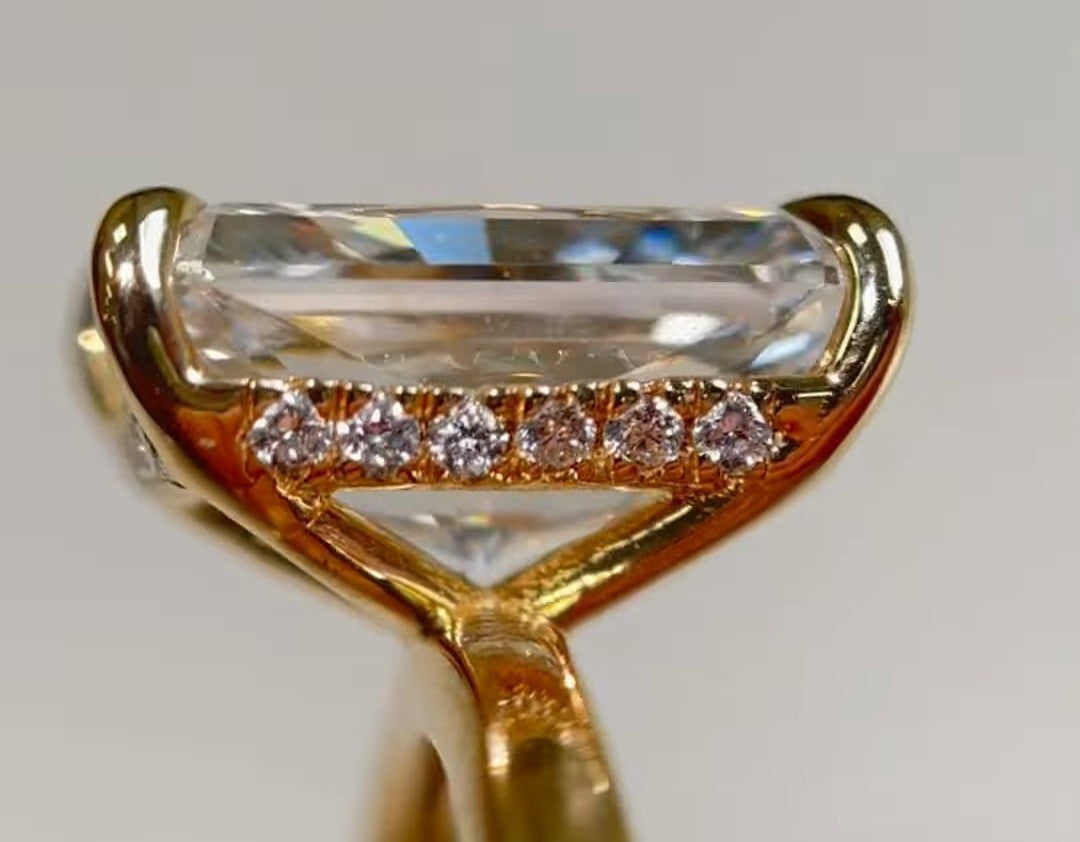

Shop finished designs in radiant lab grown diamond rings or radiant moissanite engagement rings.
Choose a radiant for sparkle with straight lines, an emerald for calm, mirror-like flashes, and a cushion for softer, rounded corners.
| Feature | Radiant | Emerald | Cushion |
|---|---|---|---|
| Corners | Cropped, straight sides | Cropped, straight sides | Rounded |
| Faceting | Brilliant, usually 70 facets | Step cut | Brilliant or modified brilliant |
| Look | Crushed ice sparkle | Hall of mirrors flashes | Softer sparkle or crushed ice, depending on style |
| Hides inclusions and color | Well | Poorly (GIA advises VS2 and G or above) | Varies by style |
Sources: GIA, The Diamond Pro. For a detailed side-by-side, read radiant cut vs cushion cut, and see every option in our guide to engagement ring shapes.
A radiant cut diamond is a square or rectangular diamond with cropped corners and brilliant-style faceting on both the crown and the pavilion. Henry Grossbard designed it in 1977 to pair the clean outline of an emerald cut with the sparkle of a round brilliant. GIA notes it usually has 70 facets and describes its look as crushed ice.
It depends on the look you want. The Diamond Pro rates 1.00 to 1.03 as excellent for a square radiant and 1.20 to 1.30 as excellent for a rectangular one. The International Gem Society suggests under 1.05 for square stones and 1.15 to 1.35 for elongated stones.
Elongated radiants can show a bow tie, a dark band across the center of the stone, much like ovals and pears. Bow ties are not listed on grading reports, so judge the diamond in a video or in person. A faint, shifting shadow is normal; a black band that stays dark as the stone moves is a sign of weak light return.
Recommendations range from H or better (The Diamond Pro, TeachJewelry) to G to J for value (International Gem Society). Radiants can show a little more color than rounds, and elongated stones show it most at the ends. For white gold or platinum, H or higher is a safe floor; in yellow or rose gold, lower grades such as J or K can still look white.
Neither is better; they suit different tastes. A radiant has brilliant faceting that produces lots of small sparkles and helps hide inclusions and warm color. An emerald cut has step facets that create broad flashes, the hall of mirrors look, but its open table shows inclusions more easily, so GIA advises VS2 clarity and G color or above for emerald cuts.


