The Geometry of Togetherness
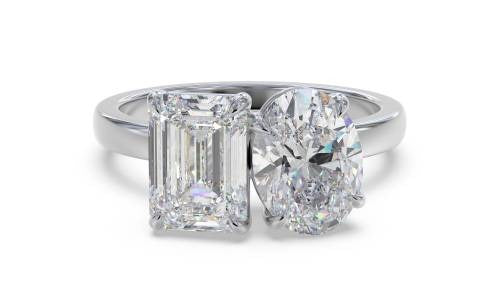
A solitaire places a single point of light on the finger. A toi et moi places two — and the space between them, the angle at which they meet, and the way they interact with each other's light become the ring's defining compositional elements. The relationship between the stones is the design.
This geometric dimension does not exist in single-stone rings. A solitaire's personality comes from the stone itself — its size, its shape, its sparkle. A toi et moi lab grown diamond ring draws its personality from how two independent optical systems coexist within a shared metal framework. Do the stones mirror each other? Do they converge toward a meeting point? Do they sit in parallel independence? Each arrangement communicates something different about the relationship it represents — and the wearer chose that communication deliberately.
Lab grown diamonds serve this format with a specific advantage that mined diamonds struggle to match: consistency. Pairing two mined diamonds of genuinely comparable quality requires searching through variable geological output for two stones that happen to match. Pairing two lab grown diamonds of comparable quality means selecting from controlled production where consistency is a feature of the process rather than a coincidence of nature. The pairing is easier to achieve, more reliable in its visual result, and less expensive to source.
Shape Combinations That Define the Format
The toi et moi's visual identity emerges from which shapes occupy its two positions — and the combinations available in lab grown diamond are limited only by the buyer's imagination.
Pear meets pear. Two teardrops oriented with their points converging toward each other — creating a visual embrace at the ring's center. The converging points produce a focal point between the stones that the eye reads as connection, contact, or meeting. This is the most overtly romantic configuration and the one that photographs with the most immediately legible symbolism.
Round meets pear. The circular stability of the round paired with the directional energy of the pear — one stone grounded, one stone reaching. The asymmetry between the two shapes creates compositional dynamism: the ring has a settled side and an active side, which prevents the design from feeling static. This is the pairing most frequently described as representing two complementary personalities.
Oval meets oval. Two elongated brilliants running in parallel along the finger — creating a wide, substantial ring presence that covers more finger than most single-stone designs. The matched shapes produce formal symmetry, and the oval's brilliant-cut fire ensures both stones contribute actively to the ring's light output.
Emerald meets round. Step-cut composure beside brilliant-cut energy — two fundamentally different optical vocabularies coexisting on a single band. This pairing appeals to buyers who want their ring to contain visual contrast rather than visual harmony. The emerald contributes depth. The round contributes sparkle. The combination produces a ring where the eye moves between two different kinds of beauty.
Marquise meets pear, cushion meets oval, heart meets round — the permutations extend as far as the buyer's design sense reaches. Each combination produces a distinct emotional and geometric signature. Grown Leo stocks popular pairings and facilitates custom combinations for buyers with specific visions.
Engineering a Ring Around Two Diamonds
The toi et moi format introduces structural requirements that single-stone rings do not encounter — and at Grown Leo, the engineering behind each ring is designed for these specific demands rather than adapted from solitaire templates.
Weight distribution across two stones creates asymmetric load patterns that a single-stone ring does not produce. If the two diamonds differ in carat weight — a common design choice — the heavier stone exerts more downward torque on its side of the band, which can cause the ring to rotate on the finger toward the heavier position. Grown Leo's band engineering accounts for this asymmetry through calibrated metal thickness on the heavier side, counterweighting the load differential to maintain centered wearing.
Stone clearance between the two diamonds must be precise. Too close and the stones contact each other during flex — diamond on diamond produces chipping at girdle contact points. Too far apart and the composition loses its sense of connection, reading as two separate rings rather than one unified design. The optimal gap depends on the shapes involved — converging points need tighter tolerances than rounded edges — and Grown Leo specifies clearance per stone pairing rather than applying a universal standard.
Prong architecture for two center-weight stones requires more total metal contact than a solitaire — typically eight to twelve prong tips rather than four to six. The prong layout must secure both stones independently while remaining visually cohesive across the ring's face. Shared prongs at the junction between the two stones can reduce visible metal but introduce a structural dependency where one prong failure compromises two gems. Grown Leo uses independent prong systems for each stone in most configurations, accepting slightly more visible metal in exchange for redundant security.
Band profile at the shank's narrowest point must carry the combined weight of both diamonds plus their settings — a total mass that can exceed what a standard engagement ring band is designed to handle. Band width and wall thickness are specified for the actual combined load rather than estimated from single-stone guidelines.
The Lab Grown Advantage in Paired Diamonds
The toi et moi format amplifies every advantage lab grown diamonds hold over mined — because every advantage applies twice.
Cost advantage doubles. Two center-weight diamonds at mined pricing produces a cost that places the toi et moi firmly in the luxury tier. Two center-weight lab grown diamonds repositions the same design into the accessible tier. The savings are not merely twice a single stone's discount — they compound with the additional matching or contrasting evaluation time that mined sourcing requires and lab grown simplifies.
Matching quality doubles in reliability. Finding two mined diamonds that present as a visually cohesive pair — consistent color, consistent brilliance, consistent size — requires sorting through geological variation. Lab grown production achieves consistency through process control, which means matched pairs emerge from the production pipeline naturally rather than requiring exhaustive search-and-compare cycles.
Ethical transparency doubles. Two stones, two traceable origins, two production paths documented from laboratory to setting. The toi et moi buyer who values ethical sourcing receives that assurance multiplied by the number of diamonds on the ring.
The format's inherent two-stone structure means it benefits from lab grown production's advantages at twice the rate of any single-stone design — which is why the toi et moi has experienced its resurgence in the lab grown era specifically, not despite it.
Wearing the Toi Et Moi Daily
The two-stone profile introduces wearing characteristics worth understanding before purchase.
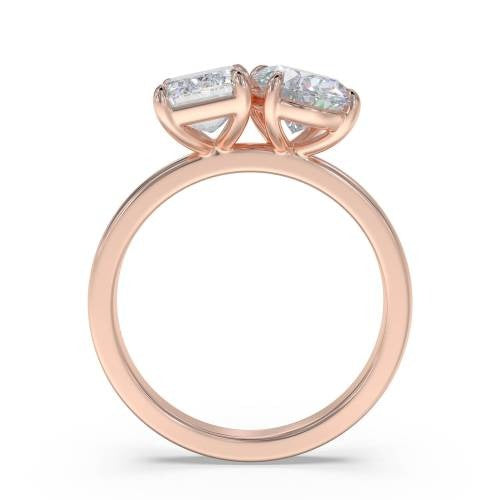
Height. A toi et moi sits taller above the finger than most solitaires because two stones must clear each other's mountings. The side profile is part of the ring's identity — and at Grown Leo, the gallery between and beneath the stones is designed as a visible architectural element rather than a structural necessity to be minimized.
Width. The ring covers more finger width than a single-stone design — particularly in side-by-side configurations where two stones occupy lateral space that a solitaire's single footprint does not. This wider profile affects how wedding bands sit alongside the ring. Curved or contoured bands designed for toi et moi pairing accommodate the wider profile without gap issues.
Rotation. The two-stone weight distribution can cause rotation if the band is not properly calibrated. Grown Leo addresses this through band engineering (see above), but the wearer should expect the ring to feel slightly different from a solitaire during the first few days of wear. Adaptation typically completes within a week.
For how Grown Leo approaches complementary ring pairing in a different design context, our oval moissanite rings demonstrate how single-stone rings are engineered for the wedding band stacking that toi et moi designs also accommodate.
Grown Leo's Pairing Protocol
Two diamonds on one ring demand evaluation that single-stone selection does not require. The stones must satisfy individually — each passing certification and visual assessment on its own merits — and then satisfy as a pair.
Color matching under three lighting conditions ensures the two diamonds present as tonally consistent across the environments the buyer will actually encounter. Two stones that look matched under jewelry-store fluorescents can diverge under warm restaurant lighting. We test under cool, warm, and natural light before approving a pairing.
Brilliance parity confirms both stones produce comparable light output. A toi et moi where one diamond outshines the other creates a visual hierarchy the format is not designed to contain — unless the buyer specifically requests asymmetric brilliance as a design choice.
Proportional harmony evaluates whether the two stones' shapes and sizes produce a composition that reads as intentionally designed. Two diamonds placed on a band is not automatically a toi et moi — it becomes one when the relationship between them is visually coherent. Our team assesses this coherence before pairing.
Every ring carries independent certification for each diamond. Settings are constructed in solid gold or platinum with dual-mount engineering. Our halo engagement rings demonstrate how the same quality rigor applies across different design formats. Craftsmanship coverage, sizing service, and a returns framework accompany every purchase.
For buyers who want to explore loose stones as a starting point for a custom toi et moi, our loose moissanite stones offer an alternative gemstone avenue for two-stone designs.
Caring for Two Diamonds on One Band
The toi et moi's dual-stone architecture introduces a specific maintenance zone that single-stone rings do not share.
The junction between the two stones — where their settings meet or nearly meet — is the primary residue accumulation site. Oils, particulate, and cosmetic products migrate into this narrow channel through daily wear and lodge in the gap where routine wiping cannot reach. A biweekly soak followed by targeted brushing with a narrow soft-bristled brush clears this junction effectively. Neglecting it produces a progressive dulling at exactly the point where the two stones' light output overlaps and should be brightest.
Each stone independently requires the same cleaning attention a solitaire center would — around the prongs, underneath the setting, and across the table surface. Two stones means two cleaning cycles in a single ring session.
The chain of prongs securing both stones benefits from annual professional inspection. More prong tips means more individual contact points subject to wear — and at Grown Leo's construction quality, failure is rare but verification is inexpensive.
Store the ring in a compartment deep enough to accommodate the taller dual-stone profile without compressing the settings against the compartment lid.