
Total: $0.00
Taxes and shipping calculated at checkout

A Portuguese cut diamond is a natural or lab grown diamond faceted in the Portuguese style: a small table surrounded by extra tiers of kite-shaped and triangular facets on both the crown and the pavilion, usually on a deep round stone. Most sellers cite about 161 facets, compared with 57 or 58 on a round brilliant, which gives a dense, kaleidoscope-like pattern of small flashes. It is a faceting style rather than an outline, it has no lab cut grade, and most Portuguese cut diamonds sold today are lab grown and often cut to order.
A Portuguese cut diamond is defined by its facet arrangement, not its outline: extra rows of facets above and below the girdle, a smaller table and a deeper profile than a standard brilliant.
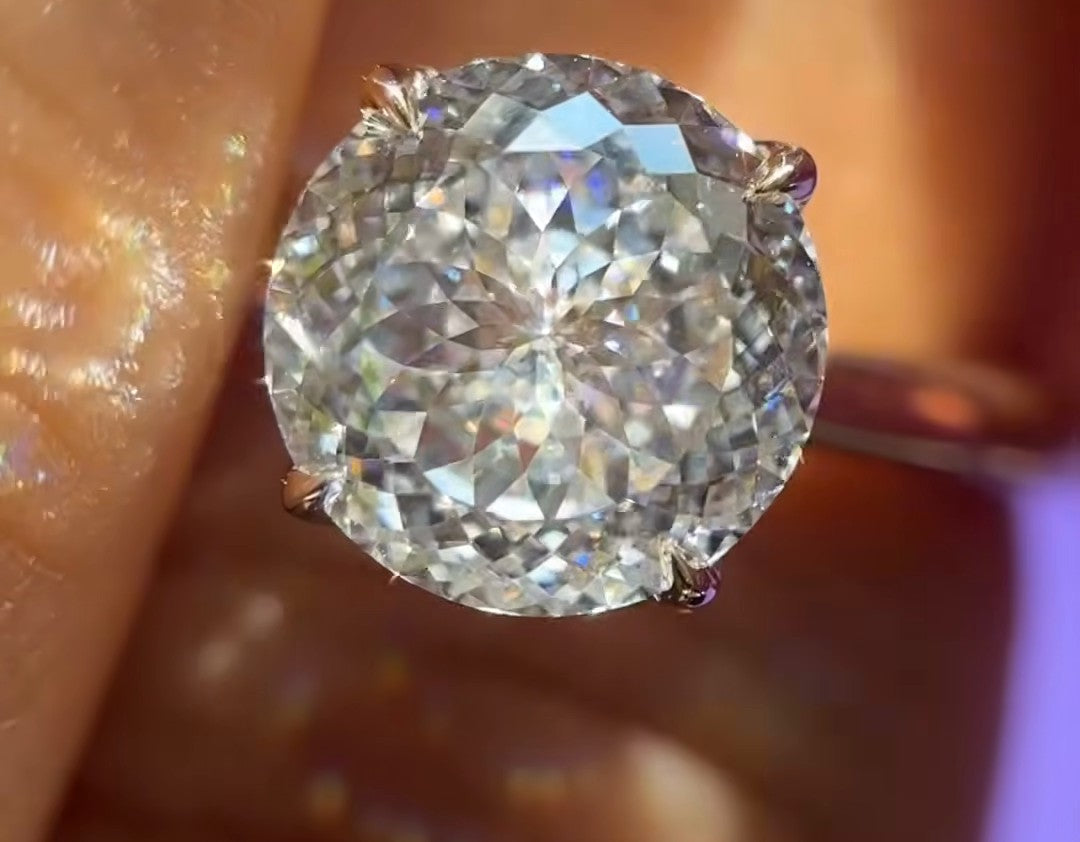
Gem dealer GemSelect describes the Portuguese cut as two rows of rhomboidal facets and three rows of triangular facets above and below the girdle, plus an extra row on the crown that makes the table smaller. Designer Diamonds adds that the pavilion is deeper than on a round brilliant. A gem cutter writing on shaopeng.blog notes that the number of rhomboid rows can be adjusted to the depth of the rough.
Winston Gems and Jewellery explains that a well-cut Portuguese diamond makes the most of diamond's dispersion, its ability to split white light into spectral colors (fire).
There is no standard facet count; most sources cite about 161, but published figures range from roughly 100 to more than 200.
| Source | Portuguese cut facet count cited |
|---|---|
| Designer Diamonds | 161 as standard; some variations exceed 200 |
| Grown Diamond Corp (buying guide) | Typically 161 to 177; more than 200 on some designs |
| Diagaa | 161 or more: about 81 on the crown and about 80 on the pavilion |
| Diamond Rensu | Over 100, up to 145 |
| Winston Gems and Jewellery (video) | Over 160 |
| Round brilliant, for comparison | 57 or 58 |
Because the name is used loosely, ask for the exact count or a facet diagram if it matters to you.
The origin of the Portuguese cut is not documented, and sources openly disagree.
Designer Diamonds and Diagaa tie the name to 18th-century Portugal, when diamonds from Minas Gerais in colonial Brazil flowed through Lisbon, and say the cut was designed to sparkle by candlelight. Designer Diamonds also states plainly that the origin is not fully documented. A gem cutter researching the style for shaopeng.blog found no documented history at all. Winston Gems and Jewellery goes further, calling it a modern designer cut and arguing that 150-plus tiny facets would have been impractical for 1800s cutters working by hand. Engage Studio says it probably began in Europe, but not necessarily in Portugal.
The cut is often confused with the Portuguese Diamond, a 127.01 carat octagonal-cut stone in the Smithsonian collection that shares only the name.
A Portuguese cut has nearly three times the facets of a round brilliant or an old mine cut, so it trades broad flashes and maximum spread for a dense, busy sparkle.
| Feature | Portuguese cut | Round brilliant | Old mine cut |
|---|---|---|---|
| Facets | About 161 cited; ranges from about 100 to 200+ | 57 or 58 | 58 |
| Outline | Mostly round; also oval and fancy shapes | Round | Squarish to rectangular cushion |
| Table | Small | Larger | Small |
| Profile | Deep pavilion | Standardized proportions | High crown, deep pavilion, large visible culet |
| Light pattern | Many small flashes | Larger, broader flashes | Chunky facets, broad flashes |
| History | Origin debated | Proportions calculated by Marcel Tolkowsky in 1919 | 18th and 19th centuries |
| Lab cut grade | None | Yes | None on the standard scale |
Old mine cut details are from GIA. For more at the other two, see our round brilliant cut diamond guide and our old mine cut diamond guide.
Round is the classic and most common Portuguese cut outline, followed by oval, but retailers now apply the style to several fancy shapes, mostly in lab grown diamonds.
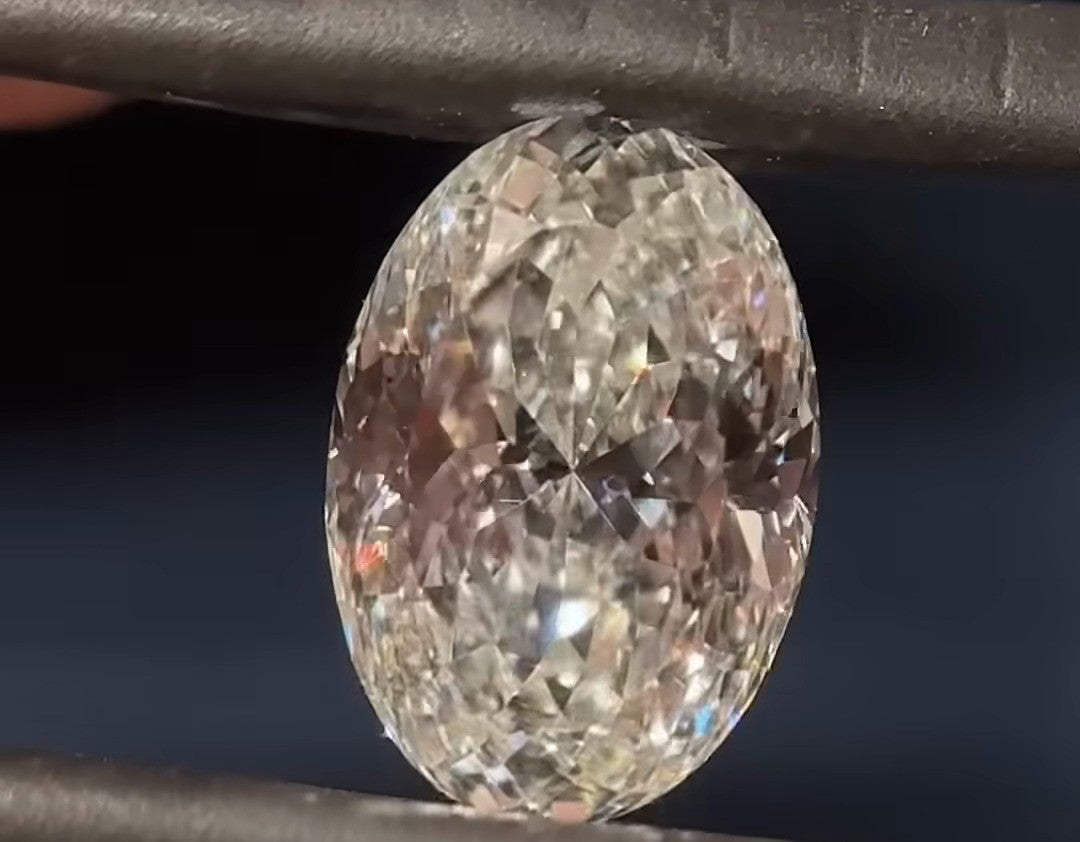
Grown Diamond Corp says the cut is applied almost always to a round outline and that oval and cushion versions are uncommon and often custom cut. Stienhardt describes it as usually round or oval. Diagaa says the style suits any diamond with a rounded core shape.
| Shape | How common | How the style looks | Listed by |
|---|---|---|---|
| Round | Most common | Balanced symmetry with very intricate scintillation | All sources |
| Oval | Traditional second choice | Elongated outline with detailed facet movement | Stienhardt, AGCO, Ouros, Diagaa |
| Cushion | Uncommon, often custom | Soft corners with layered brilliance | Grown Diamond Corp, AGCO, Ouros |
| Pear | Specialty | Teardrop outline with complex internal reflection | AGCO, Ouros, Diagaa |
| Marquise | Specialty | Long outline with fine scintillation | AGCO, Ouros |
| Princess or square | Specialty | Geometric outline with brilliant-style faceting | AGCO, Grown Diamond Corp, Ouros |
| Hexagon | Specialty | Architectural, contemporary outline | AGCO, Ouros |
| Radiant and Dutch marquise | Specialty | Listed as loose lab grown stones | Ouros |
Shape descriptions are paraphrased from AGCO Jewellery. On fancy shapes, AGCO advises checking that shoulders, corners and points look balanced, because small inconsistencies show more in an intricate design.
Yes, a Portuguese cut diamond can face up slightly smaller than a round brilliant of the same carat weight, because more of its weight sits in the deep pavilion.
Diagaa and Grown Diamond Corp both note that the stone may face up slightly smaller than its carat weight suggests, and Designer Diamonds explains that more weight sits in the depth rather than the visible diameter. Our diamond size chart shows standard round brilliant diameters by carat, which gives you a baseline to compare against the measurements on a Portuguese cut certificate.
Size also affects how the pattern reads. Grown Diamond Corp says the cut works best at around 2 carats or more, and that below 1 carat the facet pattern is hard to appreciate in most retail lighting. Winston Gems and Jewellery warns that a stone too small for the design can look dark rather than bright.
Because no lab assigns a cut grade to a Portuguese cut, you have to judge the stone itself, using its certificate, measurements and video.
A Portuguese cut engagement ring needs a setting with a little extra height for the deep pavilion, and it works in prong, halo or bezel designs.
Designer Diamonds says the deeper pavilion requires a setting with more height and recommends a custom setting built around the stone, noting that four- or six-prong solitaires, halos and bezels all suit a round Portuguese cut. Diagaa finds that solitaire and halo settings show the sparkle best. Prongs show more of the stone; a bezel adds edge protection. Grown Diamond Corp notes the deep pavilion collects dust underneath, so clean it regularly.
Winston Gems and Jewellery cautions that, as a modern designer look, the cut may feel trendy rather than classic years later.
Portuguese cut diamonds are rare because the style loses more rough, takes far longer to cut and has limited demand, so lab grown stones dominate the market.
Designer Diamonds lists high material loss, extreme symmetry demands and low mass-market demand as the reasons, adding that a Portuguese cut is usually a custom order and the best availability is in lab grown diamonds. Diagaa observes that many marketed today appear to be lab grown, and Stienhardt calls natural examples high priced and rare. Winston Gems and Jewellery links the cut's rising popularity to lab diamonds and moissanite making large stones affordable.
Grown Leo does not currently list Portuguese cut diamonds. If you want the look in a gem with even more fire, read our guide to Portuguese cut moissanite and browse Portuguese cut loose moissanite. For standard shapes, see our loose lab grown diamonds.
There is no fixed count. Most sellers cite about 161 facets, and Grown Diamond Corp says authentic versions typically fall between 161 and 177, with some designs passing 200. Diamond Rensu describes stones with over 100 and up to 145 facets. A standard round brilliant has 57 or 58. Ask the seller for the exact count or a facet diagram for the stone you are considering.
A round brilliant has 57 or 58 facets, a larger table and standardized proportions that maximize face-up size and brightness. A Portuguese cut adds extra tiers of facets on the crown and pavilion, leaving a smaller table and a deeper pavilion. It shows many small flashes instead of larger, broader ones, faces up slightly smaller per carat and receives no lab cut grade.
Round is the classic and most common outline, and sources also list oval as traditional. Retailers offer the style on cushion, pear, marquise, princess or square, hexagon, radiant and Dutch marquise outlines, mostly as lab grown stones. Grown Diamond Corp notes that oval and cushion versions are uncommon and often custom cut, so non-round shapes usually take extra sourcing time.
Nobody knows for certain. Several jewelers link it to 18th-century Portugal, when Brazilian rough passed through Lisbon, but Designer Diamonds says the origin is not fully documented. Winston Gems and Jewellery argues it is a modern designer cut. It is unrelated to the Portuguese Diamond, the 127 carat stone in the Smithsonian collection.
It can be, if you want an unusual, kaleidoscope-like sparkle and choose a stone of roughly 2 carats or more, where the facet pattern is easier to see. Lab grown rough makes larger sizes more affordable. Plan for a setting with extra height for the deep pavilion, and consider that one jeweler cautions the look may feel trendy rather than classic over time.
Grown Diamond Corp suggests G to H color for most jewelry and VS2 to VS1 clarity, warning that going below SI1 carries real risk because of the deep pavilion. If you prefer a whiter look, D to F is the safer choice. Always judge the stone from video, since the facet pattern affects how inclusions and tint show.


