Yellow Gold as a Material: What You Are Actually Choosing
Pure gold — 24 karat — is too soft for jewelry intended for daily wear. It bends, scratches, and deforms under the mechanical demands of a ring worn continuously on the hand. Every gold jewelry alloy begins with this reality and addresses it through alloying: mixing pure gold with other metals to achieve the hardness needed for practical jewelry while preserving as much of the pure gold's color and value as possible.
Yellow gold alloys achieve this through combinations of copper and silver, occasionally with small amounts of zinc or other metals, added to pure gold in proportions that determine the karat designation. The resulting alloy retains gold's characteristic warm yellow color because the alloying metals used — copper and silver in roughly balanced proportions — do not significantly shift the dominant gold tone in the way that white gold's alloying metals do.
What this means practically: yellow gold's color is intrinsic to its alloy, running through the entire piece from surface to core. There is no plating, no surface treatment, no coating that produces the color and no underlying alloy that contradicts it. When the surface of a yellow gold band develops microscopic wear from daily contact, the metal beneath is identical in color to the metal above. This is a straightforward advantage over white gold, whose bright white appearance comes from rhodium plating over an alloy that is itself slightly warm or yellowish — a surface treatment that requires periodic renewal as it wears.
The Specific Character of Yellow Gold in a Wedding Band
Choosing yellow gold for a wedding band is a choice with aesthetic implications that extend through every aspect of how the ring presents and ages.
Yellow gold reads warm. Against skin of any tone — from the palest to the deepest — yellow gold creates a visual warmth that white metals do not. It draws out warmth in skin tones that have it, and lends it to those that do not. This universally flattering quality is part of what made yellow gold the default choice for centuries before white metals became available: it simply looks good on people in a way that is difficult to articulate but immediately apparent in person.
Yellow gold reads classic. A yellow gold wedding band carries the visual language of every wedding band that has preceded it — the unbroken tradition of warm metal worn as a permanent symbol of commitment. For buyers for whom that historical continuity matters — for whom the ring's meaning is connected to the tradition it participates in — yellow gold is the material that most directly embodies that continuity.
Yellow gold reads committed. Unlike white metals whose appeal lies partly in their neutrality — their ability to recede and allow other elements to dominate — yellow gold is present. It does not disappear against the hand; it announces itself quietly and consistently. For buyers who want their wedding band to be visible as a wedding band, yellow gold's warmth serves that purpose more reliably than cooler alternatives.
14k vs 18k Yellow Gold: The Practical Difference
The karat designation of a yellow gold wedding band affects its color, its hardness, its weight, and its price — all in specific ways worth understanding before selecting.
14k Yellow Gold contains 58.3 percent pure gold, with the remainder copper, silver, and trace metals. The lower gold content relative to 18k means slightly higher copper and silver proportions, which produces a gold tone that some describe as slightly more saturated or vivid than 18k — a richer, more emphatic yellow. 14k is harder than 18k, which means it is more resistant to scratching and surface deformation under daily mechanical contact. For buyers whose hands are regularly involved in physical work, exercise, or any activity that puts mechanical stress on rings, 14k's superior hardness is a meaningful practical advantage. It is also less expensive per gram than 18k, which is relevant for wider bands and heavier profiles.
18k Yellow Gold contains 75 percent pure gold, with proportionally less copper and silver in the remaining alloy. The higher gold content produces a softer, more luminous yellow — less saturated than 14k but more closely approaching the color of pure gold. 18k is softer than 14k and will show microscopic surface wear slightly more readily under equivalent conditions. For buyers who prioritize the higher gold content designation, who prefer the specific color quality of high-karat gold, or whose lifestyle involves less physical wear on their jewelry, 18k is an entirely appropriate and beautiful choice. The additional density of 18k relative to 14k also gives bands in this karat a slightly more substantial feel on the finger — a quality some buyers specifically prefer.
Neither karat is objectively superior. The choice maps to a specific set of priorities: durability versus color saturation, practicality versus purity, price efficiency versus prestige of karat designation.
Band Profiles: Choosing How the Band Meets the Finger
A wedding band is worn for life, and the profile — the cross-sectional shape of the band — is what determines how the ring feels against the finger during every hour of that life. This is a specification that buyers often overlook in favor of visible aesthetic considerations, and it is the one they most consistently report wishing they had paid more attention to.
Comfort Fit: The single most important profile consideration for a wedding band intended for continuous wear. A comfort fit interior has a slightly convex curve rather than a flat inner surface, which means the band contacts the finger at a single narrow ridge rather than across the entire inner face. The practical result is that a comfort fit band feels lighter and less restrictive than a flat interior band of identical dimensions — the pressure of the ring against the finger is distributed along a line rather than across a face. For a band worn without removal, this difference accumulates over hours and days of wear into a meaningful comfort advantage. We recommend comfort fit interiors for all wedding bands worn continuously.
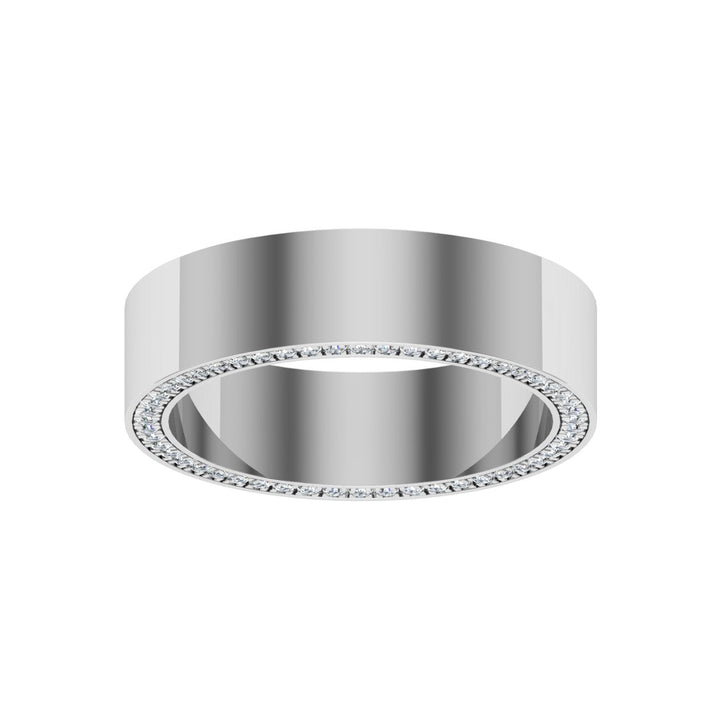
Flat Exterior Profile: A band with a flat outer surface and parallel inner and outer walls presents the metal's full width uniformly at all viewing angles. It is the most graphically resolved profile — width reads as width, and the band's top face appears as a clean, consistent plane. Finishes applied to flat exteriors read with particular clarity, making this profile the best choice for buyers who want the visual impact of a specific finish to be fully apparent.
Domed (Court) Exterior Profile: The exterior of the band arches upward from the edges to a central ridge, creating a profile that is wider at the sides than at the top. This profile has been the standard for wedding bands throughout most of modern jewelry history and remains the most commonly selected for reasons of comfort and familiarity. The dome creates visual softness that suits yellow gold's warm character particularly well.
Beveled Edge Profile: A flat exterior band with angled edges chamfered at 45 degrees creates a profile that reads as precise and engineered — contemporary in character without being severe. The beveled edges catch light differently than flat or rounded edges, creating subtle visual interest on a plain band without ornamentation.
Knife-Edge Profile: A band that comes to a ridge along the exterior centerline — the visual opposite of a domed band, with the profile's highest point at the center rather than at the edges. The knife-edge creates a distinctive silhouette that reads as refined and architectural. It is more sensitive to lateral impact than rounded profiles, which is worth considering for buyers whose bands will face regular mechanical contact.
Finish Choices and Their Long-Term Behavior
Every yellow gold wedding band begins with a surface finish decision whose implications extend through decades of wear. Understanding how each finish ages helps buyers choose with realistic expectations.
High Polish: The mirror-bright finish that is most commonly associated with yellow gold. Under ideal conditions, a high-polish yellow gold band reflects the room around it in warm, slightly distorted detail — the gold's color amplified by its own reflectivity. With daily wear, microscopic surface scratches accumulate and gradually soften the mirror reflection toward a warmer, more diffuse luster. This transition is gradual and, for most wearers, entirely acceptable — the polished band becomes a worn polished band, which is different but not worse. High polish can be restored by a jeweler's polishing process at any time, though repeated polishing over many years removes microscopic amounts of metal and gradually softens the band's edge definition.
Brushed Finish: A directional matte texture applied with fine abrasive tools, creating a surface that scatters light rather than reflecting it. Brushed yellow gold has a particularly warm quality — the scattered light from a matte surface and the metal's inherent warmth combine into a finish that reads almost like suede in quality. Brushed finishes on yellow gold develop naturally burnished areas at high-wear points over time, creating a two-tone effect between the remaining brushed texture and the naturally polished contact areas. Many wearers find this evolution beautiful; others prefer to have the finish refreshed periodically, which a jeweler can do by re-applying the brushing technique.
Hammered Finish: Intentional, irregular surface texture created through controlled metalwork — either by hand with a hammer and stake, or with a texturing tool. On yellow gold, the hammered finish creates a surface of warm, faceted reflections that catches light organically and changes continuously with movement. It is one of the most characterful finishes available, and it is among the lowest maintenance because the intentional irregularity means that incidental wear simply adds to rather than contrasting with the existing texture.
Satin Finish: A finer, more uniform version of the brushed finish, applied with finer abrasives to create a texture that reads as almost velvety rather than directionally textured. Satin finishes on yellow gold have a particularly organic quality — warm without being bright, textured without being coarse. Like brushed finishes, they are susceptible to burnishing at high-wear points, though the finer texture means this burnishing is less dramatically contrasting than on a coarser brushed surface.
Combination Finish: Some bands incorporate two finishes on the same piece — a brushed channel between high-polished edges, for example, or a hammered center band between satin borders. Combination finishes add visual complexity to a plain band and are particularly effective on wider profiles where a single finish might read as monotonous across the full band face. The practical consideration is maintenance: the different finishes develop differently with wear, and restoring a combination finish requires attending to each area separately.
Stone-Set Yellow Gold Wedding Band Configurations
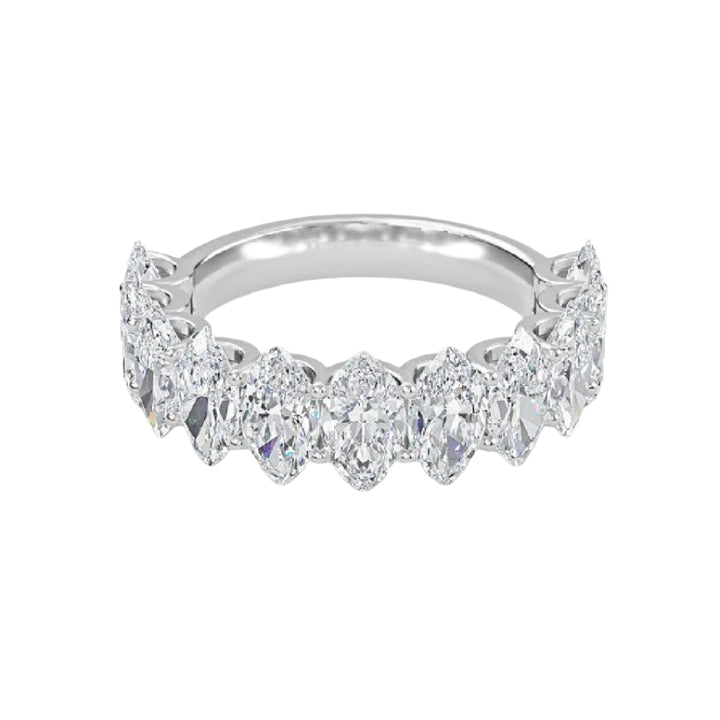
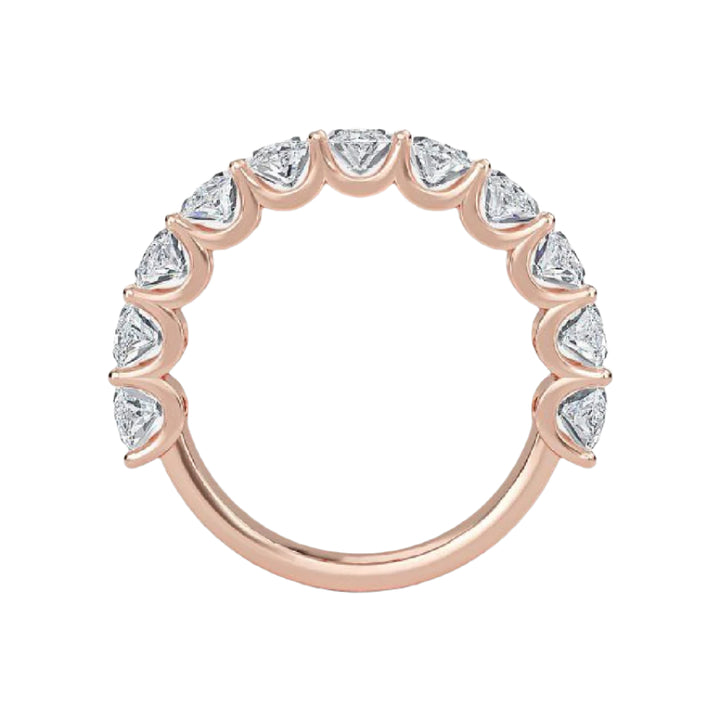
Plain yellow gold bands represent the majority of wedding band choices, but stone-set configurations offer specific combinations of brilliance and warmth that many buyers find irresistible.
Channel-Set Lab Diamond Band
Small lab grown diamonds set in a flush channel running along the top of the band create a combination of yellow gold's warmth and the diamonds' colorless brilliance that is one of fine jewelry's most enduringly appealing contrasts. The channel setting protects the stones completely — no prongs above the stone's surface — making it one of the most practical stone-set configurations for active wearers. The stones are flush with the metal, creating no surface profile that can catch on objects or materials. Channel-set yellow gold bands are resizable within a limited range depending on the channel position relative to the sizing area.
Pavé Yellow Gold Band
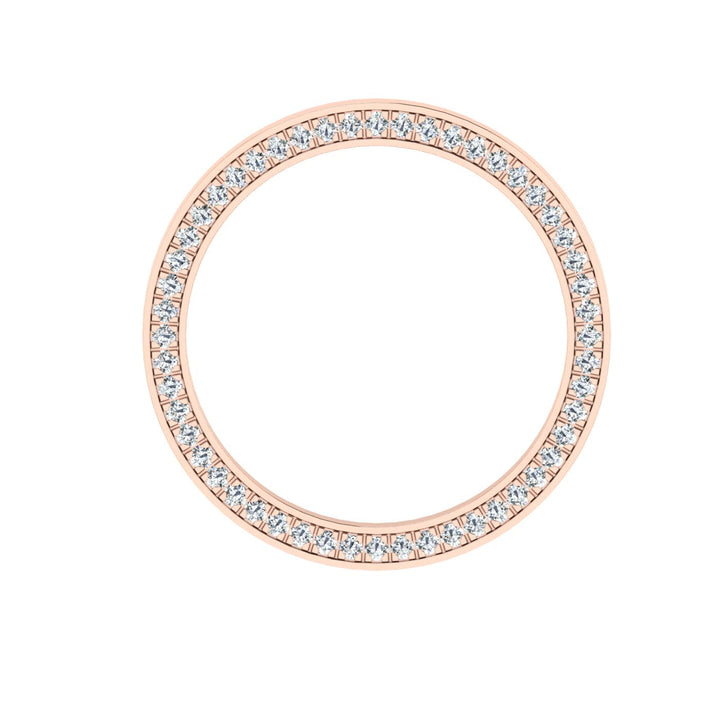
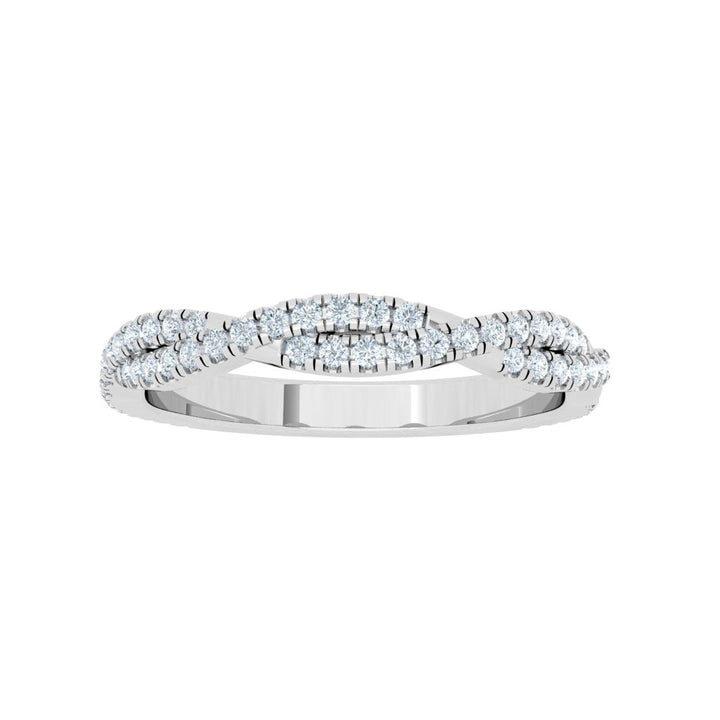
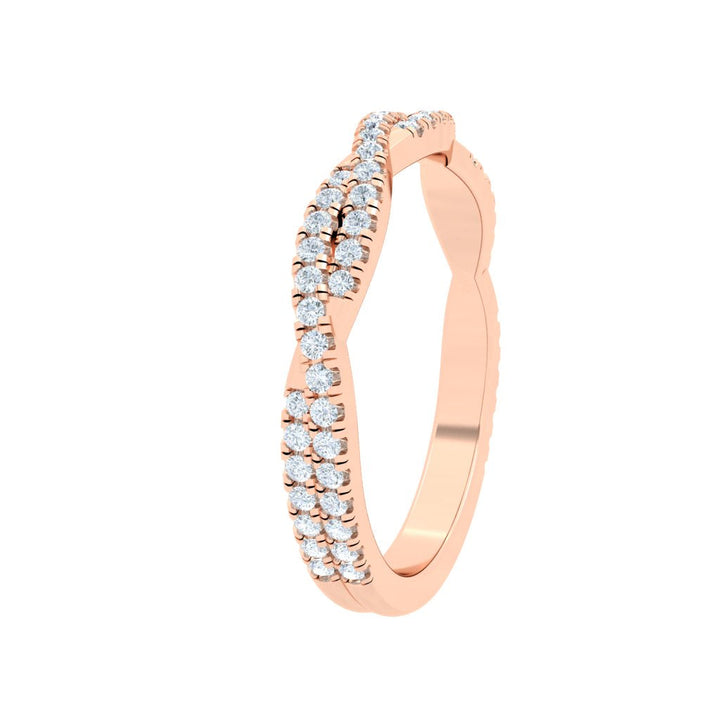
Small lab grown diamonds set closely in a pavé configuration along the band's top surface create a more continuous brilliance than a channel setting — the stones are more tightly packed, with minimal metal between them, producing a face of light rather than a row of individual stones. Pavé settings in yellow gold create a particularly warm overall character — the diamonds' colorless brilliance is framed and contextualized by the gold's warmth in a way that white metal pavé bands do not achieve. Full pavé eternity bands in yellow gold cannot be resized and require confirmed ring size before fabrication.
Flush-Set Solitaire Band
A single lab grown diamond set flush into the band's surface — the stone's table level with the metal plane, held by burnished metal rather than prongs — creates a wedding band with a single point of light that reads as deliberately understated. The flush setting is the most protected stone configuration available, with the stone recessed into the metal rather than exposed above it. For buyers who want the symbolism of a diamond in the wedding band without the profile of a raised stone, the flush-set solitaire band in yellow gold is a compelling option.
Alternating Metal and Stone Band
A band that alternates sections of yellow gold with channel or pavé-set lab diamonds creates visual rhythm along the band's length. The warmth of the gold and the brilliance of the diamonds appear in measured sequence, creating a band that catches the eye without being maximally brilliant. This configuration is particularly effective in wider profiles where the alternating sections have sufficient width to read as distinct elements.
For buyers considering how these configurations pair with existing or planned engagement rings, our yellow gold engagement ring pairings guide provides specific recommendations by engagement ring style.
Yellow Gold Wedding Bands and Their Relationship With Engagement Rings
The relationship between a wedding band and the engagement ring it will be worn alongside is the practical consideration that most buyers manage least well — typically because it requires thinking about two rings simultaneously before the second one has been selected.
Matching yellow gold sets: When both the engagement ring and the wedding band are yellow gold at the same karat, the combination reads as a unified set. The bands present as a coherent pair — same color, same quality of light, same warmth. This is the most traditional approach and the most visually resolved for buyers who value consistency.
Yellow gold band with white metal engagement ring: The deliberate pairing of a yellow gold wedding band with a platinum or white gold engagement ring creates a two-tone stack that reads as intentional and contemporary. The contrast between the warm band and the cool engagement ring is a specific aesthetic choice that many buyers now make deliberately — not as a compromise of mismatched rings but as a designed outcome. Yellow gold bands pair particularly well with white metal engagement rings that have yellow gold detail elements, such as yellow gold prongs on a white metal shank.
Yellow gold band with rose gold engagement ring: Yellow gold and rose gold exist on the same warm spectrum and pair together more harmoniously than either pairs with white metal. The slight color difference between the two — yellow gold's more emphatic warmth versus rose gold's softer blush — creates a subtle tonal variation that reads as warm layering rather than color conflict. For buyers whose engagement rings are rose gold, a yellow gold wedding band is among the most cohesive adjacent choices.
Width matching: The width of the wedding band relative to the engagement ring's band width determines how the two rings read as a stacked pair. A wedding band significantly wider than the engagement ring's shank will visually dominate the combination; a wedding band significantly narrower will disappear beside the engagement ring. For most combinations, matching the wedding band width to within 0.5 to 1mm of the engagement ring's band width creates the most visually balanced result.
The Longevity Proposition: Why Yellow Gold for a Lifetime
A wedding band is categorically different from every other jewelry purchase most people make. It is not an investment in fashion, in trend participation, or in a specific aesthetic moment. It is an investment in an object intended to be worn without interruption for the rest of the wearer's life — through work, through children, through aging hands and changing tastes and every material and circumstance that fifty or sixty years of daily wear involves.
Yellow gold has demonstrated its fitness for this specific purpose across human history in a way that no other jewelry material has. The ancient Romans wore yellow gold wedding rings. Medieval European traditions passed down yellow gold bands across generations. The yellow gold bands in estate jewelry collections from the early twentieth century look, after decades of wear, exactly like what they are: objects that have participated fully in a human life and emerged intact, still beautiful, still exactly what they were made to be.
This is not nostalgia. It is evidence about material performance across time that no laboratory test replicates. Yellow gold does not tarnish, does not degrade, does not lose its identity with wear. It develops a patina — a lived-in quality — that most wearers find increases rather than diminishes the ring's meaning over time. For a purchase whose entire purpose is permanence, yellow gold is the material with the longest and most consistent track record of delivering it.
Grown Leo's Commitment to Yellow Gold Craftsmanship
Every yellow gold wedding band in our collection is fabricated in solid 14k or 18k yellow gold — the alloy composition documented, the karat verified, and the metal provenance traceable. We do not sell gold-plated or gold-filled bands described as gold. The piece you purchase is gold through its entire cross-section.
Band dimensions — width, thickness, and profile — are as specified in each listing and verified before shipping. Finishes are applied consistently and checked under magnification. Stone-set bands are inspected for setting integrity before the ring ships. Every band travels to its buyer insured and tracked, with a certificate of metal authenticity and, for stone-set bands, documentation of the lab grown diamonds set within them.
Our 30-day return policy applies to unworn bands in original condition. Sizing is performed before shipping when the buyer's ring size is confirmed; our complimentary first-year resize handles adjustments needed after delivery. Our lifetime craftsmanship warranty covers setting and fabrication defects for the life of the ring.
We take no shortcuts in yellow gold fabrication because the people who choose yellow gold wedding bands are, in our experience, the buyers who most clearly understand that a wedding band is for life and whose expectations for durability and longevity are consequently the highest.
Care and Maintenance for Yellow Gold Wedding Bands
Yellow gold's care requirements are straightforward, and understanding them establishes realistic expectations for how the band will look and perform across decades of wear.
Routine cleaning: Warm water with a mild dish soap, applied with a soft cloth or soft brush, cleans yellow gold safely and effectively. Work the brush or cloth around any stone settings to dislodge accumulated residue. Rinse thoroughly under clean water — soap residue left in settings dulls stones — and dry with a lint-free cloth. For most wearers, weekly cleaning keeps the band looking consistently good.
Chemical exposure: Yellow gold alloys are susceptible to surface dulling and, in extreme cases, metal fatigue from prolonged exposure to strong chemicals. Household bleach and chlorine — found in swimming pools and hot tubs — are the primary concerns. Neither causes immediate visible damage in brief contact, but regular exposure over time degrades the alloy surface and can eventually cause structural weakness in thinner bands. Remove yellow gold bands before swimming in chlorinated water and before using bleach-based cleaning products.
Physical wear: Yellow gold at 14k or 18k will develop microscopic surface scratches with daily wear. This is expected, normal, and not a sign of poor quality — it is simply the physics of metal in contact with the world. The accumulation of these scratches gradually transforms a polished surface toward a patina, which most wearers find appropriate and appealing in a wedding band. If the original polished surface is preferred, a jeweler can restore it through professional polishing; plain bands can be polished quickly and inexpensively.
Stone security for set bands: Pavé and channel-set stones in yellow gold bands warrant annual inspection to confirm that settings remain secure. Yellow gold's relative softness compared to platinum means that prong tips and bead settings in yellow gold wear more quickly under mechanical contact than equivalent settings in harder metals. This is manageable with periodic professional attention — prong re-tipping and bead restoration are straightforward procedures — but requires that the attention actually happens. Do not defer stone security inspections indefinitely.