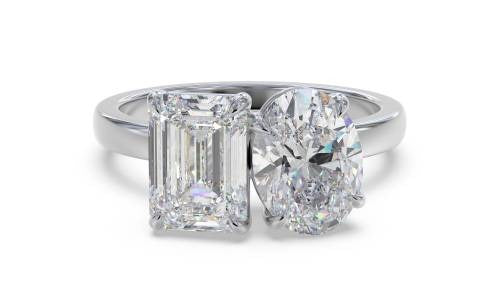
The Toi et Moi Tradition — Reclaimed
The two-stone ring format — historically known as toi et moi, French for "you and me" — traces its origins to 18th-century European aristocracy, where a ring bearing two gemstones symbolized the union of two individuals. Napoleon Bonaparte gave Josephine a toi et moi ring with a sapphire and a diamond in 1796. The format carried romantic symbolism through the Victorian and Edwardian eras before fading into relative obscurity as the solitaire diamond captured the 20th-century engagement ring market.
The format is now experiencing a full resurgence — driven by a generation of couples who want their ring to express their relationship rather than conform to a template. Two stone lab grown diamond rings answer that desire with a design that is inherently personal: the pair of stones can match (symbolizing equality), contrast (symbolizing complementarity), or combine different shapes (symbolizing individuality within unity).
Lab grown diamond production makes the toi et moi accessible in ways the historical versions never were. Matching two natural diamonds of equivalent quality was an expensive, supply-constrained exercise. Matching two lab grown diamonds — or pairing a lab grown diamond with a moissanite — is straightforward, consistent, and affordable enough that the format becomes a real option for couples who want it, not a luxury reserved for those who can source it.
Why Two Stones Change the Ring's Meaning
A solitaire speaks in the first person. It says: here is a diamond. Admire it. A two-stone ring speaks in the second person. It says: here are two things, side by side, and the relationship between them is what you are looking at.
This shift from object to relationship fundamentally changes how the ring communicates. Viewers do not simply assess the stones' individual quality — they evaluate the dialogue between them. Are they matched in size? In shape? In color? Do they lean toward each other, away from each other, or sit in parallel? Each configuration carries its own narrative, and the wearer chose that narrative deliberately.
The format also introduces a visual dynamism that single-stone designs cannot achieve. Two stones interact with light independently — each one catching and returning ambient light at its own angle, its own rhythm, and its own spectral composition. The result is a ring that produces two simultaneous but non-identical sparkle patterns, which the eye processes as visual complexity rather than uniform brightness. The ring is busier than a solitaire — not in a cluttered sense, but in the way a duet is busier than a solo. There is more happening, and the interplay is the point.
Formats and Configurations
Two stone lab grown diamond rings are not a single design — they are a format that accommodates a wide range of configurations, each producing a distinct visual and symbolic outcome.
Matched pair. Two stones of identical shape, size, and quality set in symmetrical positions on the band. This is the most balanced configuration — egalitarian, harmonious, and quietly powerful. The ring reads as a statement of equality: two elements of equal weight sharing a single platform. Round with round, oval with oval, emerald with emerald — the matching reinforces unity.
Contrasting shapes. A pear paired with a round. An emerald beside a cushion. An oval meeting a marquise. Mixing shapes introduces geometric tension that makes each stone more visually interesting than it would be alone. The contrast is deliberate — symbolizing the differences that make a partnership dynamic rather than static. This is the configuration that draws the most compliments because it invites the viewer to interpret the pairing.
Asymmetric sizing. One larger stone and one smaller — the pair intentionally unequal. The larger stone anchors the design while the smaller one orbits it. This can represent a parent and child, a mentor and partner, or simply a compositional preference for visual asymmetry. The unequal sizing produces a ring with directional flow — the eye moves from larger to smaller, creating visual narrative.
Bypass configuration. The two stones sit at the open ends of a band that does not close — the shank splits, and each arm terminates in a gem. The stones face each other across the gap, producing a ring with dynamic tension. The bypass format is inherently modern and works especially well with elongated shapes like pears and marquises, whose pointed ends can direct visual energy toward or away from each other.
For buyers exploring the individual stones that might populate a two-stone design, our loose moissanite stones offer the widest selection of shapes and sizes to pair according to your own design logic.
Gemstone Pairing Options
Two stone rings open a pairing dimension that single-stone formats do not possess — the choice of what each stone is, not just what the center stone is.
Diamond and diamond. Two lab grown diamonds of matched or complementary quality. This is the most traditional pairing and the one that carries the strongest fine jewelry credentials. Matching the 4Cs across both stones produces seamless visual unity. Deliberately varying one specification — different shapes at the same color and clarity, for instance — introduces controlled contrast within a consistent quality framework.
Moissanite and moissanite. Two moissanite gems, delivering more fire and rainbow dispersion per stone than diamond while keeping the total cost at its most accessible. For buyers who want the toi et moi format with maximum sparkle at maximum value, the double-moissanite pairing is the most optically dramatic option in the collection.
Diamond and moissanite. One stone from each gemstone — combining diamond's prestige and white brilliance with moissanite's superior fire and spectral color. This mixed pairing is unique to modern jewelry and carries a symbolism of its own: two different materials, equally permanent, coexisting on a single band. The optical contrast between diamond's cooler sparkle and moissanite's warmer fire creates a visual dialogue that matched-gemstone pairings cannot produce.
Each combination is available across our full metal range — white, yellow, and rose gold in 10K, 14K, and 18K, as well as platinum. Metal selection interacts with the gemstone pairing to set the ring's overall tonal character.
Design Considerations for Two-Stone Rings
Building a ring around two stones introduces design variables that solitaire construction does not encounter. Understanding them leads to better outcomes.
Stone alignment determines the ring's visual energy. Parallel alignment — both stones oriented the same direction — produces calm symmetry. Converging alignment — stones angled toward each other — produces intimacy. Diverging alignment — stones pointing away — produces independence. The choice is symbolic and aesthetic simultaneously.
Prong architecture doubles in complexity. Each stone requires its own secure mounting, and the two mounting systems must coexist within a single ring without interfering with each other structurally or visually. Shared prongs between adjacent stones can reduce metal visibility while introducing a structural dependency — if one prong serves both stones, its failure affects two gems rather than one. Independent prong systems provide redundant security at the cost of slightly more visible metalwork.
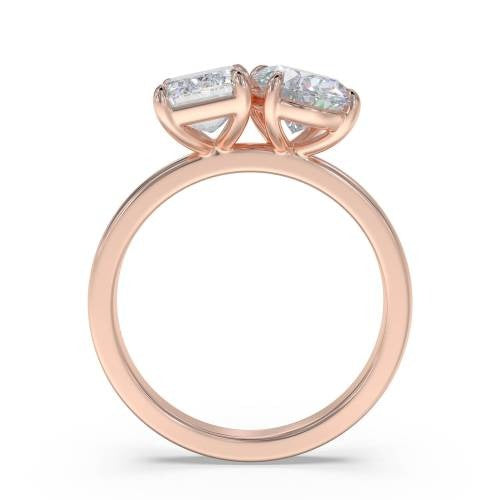
Band engineering must account for the weight and leverage of two center-weight stones rather than one. The band bears more total mass and manages more complex torque dynamics — particularly in asymmetric or bypass configurations where the weight distribution is not centered. Adequate band width and metal thickness prevent the gradual deformation that two-stone load patterns can produce over years of daily wear.
Profile height is typically higher than a solitaire because two stones must clear each other's mountings. The side profile of a two-stone ring is part of its visual identity — and at Grown Leo, we engineer that profile to be a design feature (visible gallery work, decorative bridge elements) rather than a structural necessity the eye is expected to overlook.
Our halo treatments can be applied to one or both stones in a two-stone design — adding a border of accent sparkle that amplifies each gem's presence while visually unifying the pair within a shared brightness field.
Who Chooses a Two-Stone Ring
The two-stone format attracts buyers whose relationship to jewelry — and to their relationship — resists single-stone convention.
Couples who see their partnership as a conversation rather than as one person's gesture to another. The two-stone format distributes the ring's symbolism across two elements rather than concentrating it in one — which mirrors how many modern couples experience their partnership: as a collaboration between equals rather than a unidirectional offering.
Buyers marking a second chapter. Anniversary upgrades, recommitments, and vow renewals all carry a narrative of two — two people, two timelines, two decisions to continue. The toi et moi format embeds that duality into the ring's physical structure.
Style-driven buyers who want a ring that provokes conversation and resists easy categorization. Two-stone rings are uncommon enough to be distinctive and structured enough to be recognizably fine jewelry. They exist in the space between conventional and avant-garde — designed, intentional, and impossible to mistake for anything purchased on autopilot.
Buyers who connect with the historical tradition. Napoleon's ring for Josephine. The Victorian toi et moi. The Edwardian twin-stone. The format carries centuries of romantic precedent that a solitaire — despite its dominance — cannot claim in the same personal, partner-specific way.
Grown Leo's Approach to Two-Stone Rings
Pairing two stones for a single ring requires an evaluation discipline that single-stone selection does not demand. The stones must work as individuals and as partners — and the second criterion is where most mass-market jewelers fall short.
We match or contrast stones with deliberate attention to how they will read side by side on a hand. For matched pairs, we verify color consistency under three lighting conditions — because two stones that look identical under one light can diverge under another. For contrasting-shape pairs, we evaluate whether the geometric dialogue between the two forms reads as intentional composition or accidental proximity. For asymmetric sizing, we confirm the size ratio produces the visual hierarchy the buyer intends.
Settings are fabricated in solid gold and platinum with dual-mount engineering that provides independent security for each stone while maintaining a unified ring structure. Band width and profile height are specified for the combined weight of both gems — not estimated from single-stone templates.
Every purchase includes certification for lab grown diamond stones, craftsmanship coverage, sizing service, and a returns framework designed for confident two-stone purchasing.
Our oval moissanite rings showcase how the same craftsmanship and stone-evaluation standards extend across our single-stone collections — the quality infrastructure is consistent regardless of how many stones the ring carries.
Caring for a Two-Stone Ring
Two-stone rings require the same fundamental care as any fine jewelry — with one additional point of attention.
Clean biweekly with warm water, mild soap, and a soft brush. Work around each stone individually, paying attention to the junction where the two mountings meet — this is the area most prone to residue buildup because the gap between the stones creates a sheltered zone where oils and particulate accumulate out of easy reach. A brush with a narrow head or a soft-bristled interdental brush can access this junction effectively.
Check prong security for both stones during routine visual inspections — and have a jeweler confirm both mounting systems during annual professional evaluation. A prong failure in a two-stone ring has twice the consequence potential if shared prongs are involved.
Protect the metalwork from sustained chemical exposure. Store the ring in a soft compartment that accommodates its dual-stone profile height without compressing the mountings against other pieces.