The Tennis Bracelet's Specific Place in Fine Jewelry
The tennis bracelet occupies a category in fine jewelry that has no precise equivalent: it is simultaneously the most formal and the most casual piece a person can wear, the most understated and the most substantial, the easiest to justify and the hardest to define. Understanding why it holds this position helps buyers understand what they are actually choosing when they select one.
The tennis bracelet's cultural moment arrived in 1987, when professional tennis player Chris Evert stopped a match at the US Open to search for a diamond bracelet that had come unclasped during play. The interruption — and the bracelet — received enough attention that the style became associated with her name and her sport permanently. The "tennis bracelet" designation is a specific piece of American cultural history embedded in a jewelry category.
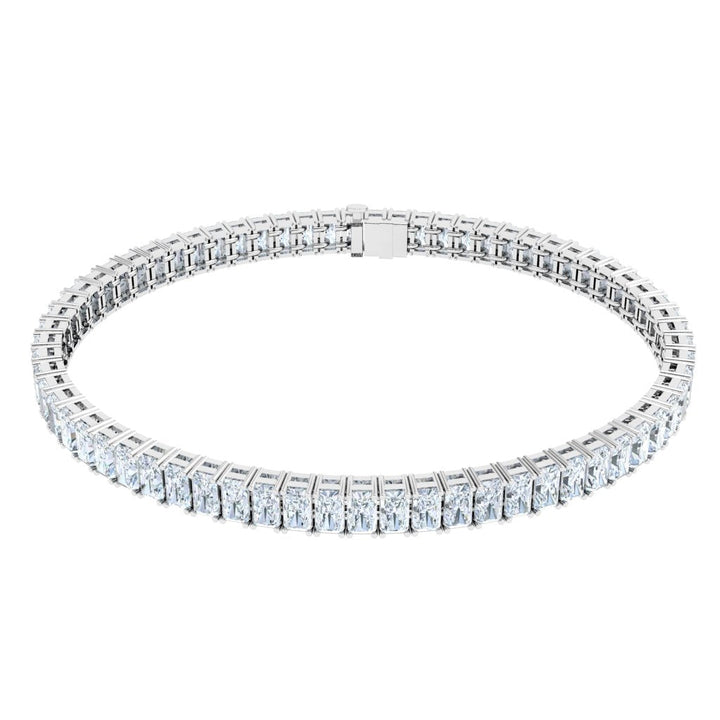
What the name attached to was already an established fine jewelry form: a flexible bracelet of individually set diamonds linked continuously around the wrist, elegant in its repetition, impressive in its total diamond weight, and democratic enough in its design that it suited any wrist and any occasion. The cultural moment gave a common name to something that already existed and already worked — which is part of why the designation has lasted.
The form's endurance across more than three decades of changing jewelry trends is not sentimental attachment to a cultural moment. It is the result of a design that genuinely solves the problem it was designed for: how to wear a significant amount of diamond around the wrist in a way that moves naturally with the body, presents beautifully from every angle, requires no specific occasion to justify, and improves rather than complicates any combination of clothing and jewelry it accompanies.
What Makes a Tennis Bracelet Worth Owning
Not all tennis bracelets are equal, and the specifications that separate an exceptional piece from an adequate one are worth understanding before any purchase at this price point.
Diamond quality throughout, not just in certain links
A tennis bracelet contains many individual diamonds — depending on the bracelet's length and stone size, anywhere from 30 to over 100 individual stones set in a continuous line. The optical character of the finished piece depends on every stone in the line, because the eye travels across all of them simultaneously. A bracelet where the individual stones vary in cut quality, color, or clarity will present unevenly — some sections appearing more brilliant than others, the continuous line of diamonds reading as inconsistent rather than uniform.
Quality tennis bracelets use stones that are matched across the bracelet's length: consistent cut quality, consistent color grade, consistent clarity grade, consistent face-up dimensions. The matching process is more demanding than selecting individual stones because it requires not just that each stone meets a grade specification but that the stones read as consistent when assembled in sequence. Our lab grown diamond tennis bracelets are assembled from matched stones throughout — the same grade, the same cut proportions, the same face-up dimensions from the first link to the last.
Setting security as a long-term consideration
A tennis bracelet worn on the wrist experiences more mechanical contact with the environment than a ring worn on the finger — it contacts desk surfaces, clothing, car interiors, and every surface the wrist encounters throughout the day. The prong work that holds each stone must maintain its security under this contact pattern over years of wear, which makes setting quality more consequential for a bracelet than for many other fine jewelry forms.
Four-prong settings for each individual stone provide the optimal balance of stone security and light admission — four prongs hold each stone from four cardinal points while leaving the majority of each stone's surface exposed to light. Prong tips that are well-formed and adequately sized maintain their grip on the stone's girdle under the mechanical contact that daily bracelet wear involves. We inspect setting security across every link before any bracelet ships.
Clasp integrity
The clasp of a tennis bracelet is its most structurally critical component and its most commonly overlooked specification. A bracelet whose clasp fails under normal conditions is a bracelet that risks being lost — and a continuous line of diamonds lost from a wrist is a loss more difficult to recover from than a ring that falls from a finger onto a surface. Box clasps with safety catches — the standard for quality tennis bracelets — provide two independent closure mechanisms that must both be disengaged for the bracelet to open. The safety catch prevents accidental opening even when the primary clasp latch is disengaged by incidental contact. We use double-safety box clasps on every tennis bracelet in our collection as a non-negotiable specification.
Lab Grown Diamonds in a Tennis Bracelet: The Compounding Advantage
The financial advantage of lab grown diamonds over mined diamonds compounds in a tennis bracelet in a way that is unique to multi-stone jewelry: because the bracelet contains many individual diamonds rather than one, the cost saving applies to every stone simultaneously.
A 3 carat total weight tennis bracelet contains the equivalent diamond weight of a 3 carat engagement ring center stone — but distributed across 30 to 50 individual stones rather than concentrated in one. In a mined diamond context, those 30 to 50 individual stones each carry their own per-carat premium for their size tier, and the total cost of the bracelet reflects that multiplied premium structure. In a lab grown context, the premium structure that inflates mined diamond pricing at every size tier is absent across every stone in the bracelet simultaneously. The savings do not apply once — they apply to every link.
This compounding effect means that the absolute price difference between a lab grown tennis bracelet and a mined equivalent of equivalent grade specifications is larger, proportionally, than the equivalent comparison for a single-stone ring. A buyer who finds the lab grown savings on a 1 carat ring meaningful will find the lab grown savings on a 3 carat tennis bracelet transformative.
Every diamond in our tennis bracelets is individually certified or certified as part of a verified matched parcel — the grade specifications are documented rather than represented without verification. The transparency that independent certification provides for single stones is preserved across the full bracelet in our collection.
Diamond Size Options and What They Mean for the Finished Bracelet
Tennis bracelets are offered in different individual stone sizes, which affects the bracelet's total visual character, its total carat weight at any given length, and its overall proportion on the wrist. Understanding these differences helps buyers select the configuration that suits their wrist and their preference for the bracelet's visual presence.
Smaller individual stones (approximately 0.06 to 0.10 carats per stone): Bracelets with smaller individual stones have a finer, more delicate visual texture — the diamonds are individually small, but the continuous line of stones creates a brilliance that reads as a unified band of light rather than as individual stones. These configurations suit buyers who prefer a more understated presence on the wrist and those who wear the bracelet as part of a stack alongside other bracelets, where the finer texture integrates without visual competition. They are also the configurations that allow the highest stone count for a given carat weight, which can create a very full and continuous appearance.
Medium individual stones (approximately 0.10 to 0.18 carats per stone): The most widely selected stone size range for tennis bracelets, medium stones create a bracelet where individual diamonds are clearly visible as distinct stones while still reading as a continuous line. The balance between visible individual stone presence and continuous linear brilliance is most fully realized at this size range. A bracelet at this stone size reads as clearly impressive from a social distance while retaining the delicate flexibility that makes the tennis bracelet format work physically on the wrist.
Larger individual stones (approximately 0.20 carats per stone and above): Bracelets with larger individual stones are more substantial in both visual weight and physical presence on the wrist. Each stone is individually apparent and contributes clearly to the bracelet's total impression. These configurations suit buyers who want the bracelet to read as a statement piece — a dominant element of the wrist presentation rather than an accent within a stack. They also tend to be wider at the wrist due to the larger individual settings, which affects how they move and sit on the wrist. For buyers with larger wrists or those who prefer the feel of a more substantial bracelet, larger stone configurations produce a result that feels proportionally appropriate.
Metal Options for Lab Grown Diamond Tennis Bracelets
The metal of a tennis bracelet affects its color tone, its weight on the wrist, its long-term maintenance requirements, and its compatibility with other jewelry the wearer may wear simultaneously.
White Gold Tennis Bracelet
An 18k white gold tennis bracelet creates the most visually neutral setting for the diamonds — the white metal recedes, allowing the stones' combined brilliance to read without warm or cool interference from the links. The rhodium plating that gives white gold its bright white finish applies to the bracelet's many individual links and clasps, and the plating at high-contact wear points — the inner face of the links that contacts the wrist — will wear through more quickly on a bracelet than on a ring due to the continuous skin contact and movement. Periodic re-plating maintains the appearance as needed; most white gold tennis bracelet wearers find that a once-yearly re-plating visit keeps the bracelet looking its best.
Yellow Gold Tennis Bracelet
A yellow gold tennis bracelet is the configuration with the deepest historical resonance — diamond tennis bracelets have been made in yellow gold since the form's origin, and the warm metal and colorless diamonds create a contrast that reads as simultaneously classic and luxurious. Yellow gold's alloy color is intrinsic rather than surface-applied, meaning it does not require re-plating to maintain its appearance. A yellow gold lab grown diamond tennis bracelet ages gracefully — the gold develops a natural patina over years of wear that most wearers find appropriate and beautiful in a piece meant to be worn constantly. For buyers whose existing jewelry runs warm-toned, yellow gold creates a coherent overall wrist presentation.
Rose Gold Tennis Bracelet
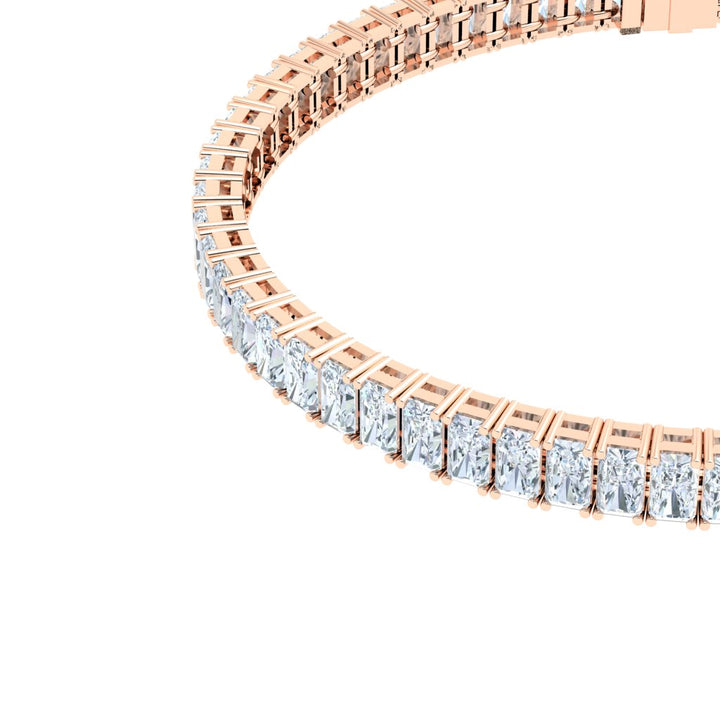
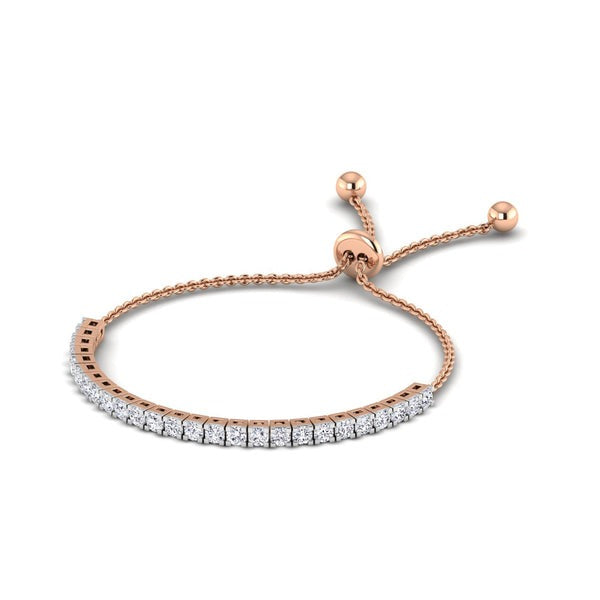
A rose gold tennis bracelet brings a romantic warmth to the form that white and yellow gold do not replicate. The blush tone of the rose gold links creates a softer overall impression than yellow gold's richer warmth or white metal's cool neutrality — a visual register that suits the tennis bracelet's face-adjacent position on the wrist particularly well. Rose gold's copper content makes the alloy slightly harder than equivalent yellow gold, which benefits a bracelet's resistance to the surface wear that daily contact produces. For buyers who want their tennis bracelet to read as distinctly contemporary while maintaining the warmth of a precious metal setting, rose gold is the most personal of the available choices.
Platinum Tennis Bracelet
A platinum tennis bracelet provides the most structurally sound setting for the diamonds across the full length of the piece — platinum's density and hardness maintain the prong geometry that holds each stone securely over years of continuous wear better than lighter alloys. The maintenance-free white appearance — no rhodium plating required — is particularly relevant for a bracelet where the plating wear at the wrist contact surface would be more pronounced than in a ring. Platinum's premium over gold alloys is meaningful for a multi-link bracelet where the total metal weight is significantly more than in a single ring, making it the highest-cost metal option. For buyers who want the best long-term structural performance and freedom from re-plating maintenance, platinum justifies the premium.
Setting Styles for Tennis Bracelets
Classic Four-Prong Setting
The standard tennis bracelet setting uses four prongs per stone — one at each cardinal point of each diamond's girdle. This configuration provides secure stone retention while leaving the maximum stone surface exposed, allowing each diamond's brilliance to contribute fully to the bracelet's overall light performance. Four-prong settings create a consistent visual rhythm along the bracelet's length — the prong tips visible between each stone creating a regular pattern that reinforces the bracelet's continuous character. This is the setting that has defined the tennis bracelet category since its establishment, and it remains the best balance of security, light admission, and aesthetic resolution.
Bezel-Set Tennis Bracelet
A bezel-set tennis bracelet encloses each individual diamond in its own continuous metal rim, creating a bracelet with a smooth, uninterrupted surface along its length. The bezel setting's fully enclosed stones have no prong tips that can catch on clothing or snag on surfaces, making this the most practical configuration for active wearers and those who wear the bracelet during activities where a prong-set piece would require removal. The bezel also provides complete edge protection for each stone. The trade-off is a slight reduction in per-stone brilliance relative to prong settings — the bezel's metal rim at the stone's perimeter reduces lateral light admission — but the total bracelet impression remains substantial because the combined face-up surfaces of all the stones are fully exposed.
Channel-Set Tennis Bracelet
A channel-set tennis bracelet places each diamond between two parallel metal rails that run continuously along the bracelet's length, holding all stones flush within the channel. This creates the smoothest possible bracelet surface — no prong tips, no individual bezels, just a continuous channel of diamonds set flush with the metal on either side. The channel setting is excellent for active wearers and produces a sleek, contemporary aesthetic that differs from the more traditional four-prong appearance. Individual stone security in a channel setting depends on the channel's integrity — the metal rails that hold all stones must maintain their dimensional accuracy along the full bracelet length.
Shared Prong (Shared Claw) Setting
A shared prong tennis bracelet uses prongs positioned between adjacent stones — each prong shared by the two neighboring diamonds it separates — rather than individual prongs per stone. The shared prong configuration reduces the total amount of metal between stones, allowing more of each stone's face-up surface to be visible from the front and creating a bracelet that appears to have more continuous diamond coverage than a four-prong setting of equivalent stone size. The visual effect is a closer approximation of a continuous line of diamonds, with minimal metal interruption between individual stones. Our lab grown diamond tennis bracelet styles include both classic four-prong and shared prong configurations across all metal types.
Total Carat Weight Options and How to Think About Them
Tennis bracelets are typically described by total carat weight — the combined weight of all diamonds along the bracelet's length. This number is the primary specification most buyers use to compare bracelets, but understanding its relationship to the bracelet's actual appearance helps buyers calibrate their expectations.
Total carat weight is a function of two independent variables: the number of stones in the bracelet and the size of each individual stone. Two bracelets with identical total carat weight can look very different if one achieves that weight through many small stones and the other through fewer larger stones. A 3 carat bracelet with 50 stones of 0.06 carats each will look and feel different from a 3 carat bracelet with 15 stones of 0.20 carats each — the first with a finer, more delicate texture and the second with individually visible, more substantial stones.
When selecting a tennis bracelet by total carat weight, also consider the individual stone size — the two specifications together determine the finished bracelet's character more completely than total carat weight alone.
2 carat total weight: A starting point for buyers who want a clearly present bracelet with noticeable diamond coverage. Depending on stone size, this range creates a bracelet with good visual presence that is appropriate across all formality levels.
3 carat total weight: The most widely selected total weight range in our collection, 3 carats creates a bracelet that reads as clearly substantial and impressive from a social distance. At medium individual stone sizes, this produces a bracelet of genuinely luxurious appearance at lab grown pricing that makes the specification accessible rather than exceptional.
4 to 5 carat total weight: The range where a tennis bracelet becomes a wrist focal point — a piece that reads as a statement from the first glance. These configurations suit buyers who want the bracelet to dominate their wrist presentation and who wear it as a singular piece rather than as part of a stack.
Above 5 carats: A bracelet that creates genuine impact from across a room, with individual stones large enough to be individually impressive as well as collectively spectacular. These are the configurations that require no stacking partners and no occasion justification — they create their own context.
Tennis Bracelet Sizing: Getting the Fit Right
A tennis bracelet's fit governs both its comfort and its appearance on the wrist, and the fit relationship is different from ring sizing — a bracelet can be too loose, too tight, or just right in ways that affect how it drapes and moves during wear.
The standard guideline for tennis bracelet sizing is to add approximately half an inch to one inch (1.25 to 2.5cm) to the wrist circumference measurement. This allowance allows the bracelet to drape naturally along the wrist's contour, move freely during hand and arm movement without bunching, and sit comfortably without creating pressure points or gaps so large the bracelet slides toward the hand.
Wrist measurement is best taken with a flexible tape measure wrapped around the wrist at the point where the bracelet will be worn — typically just above the wrist bone. If a flexible tape measure is not available, a strip of paper wrapped around the wrist and then measured flat against a ruler produces an accurate measurement. Average adult wrist sizes fall between 6 and 7 inches (15 to 18cm), with standard bracelet lengths of 6.5 to 7 inches accommodating most wrists with appropriate allowance.
Buyers who are purchasing a tennis bracelet as a gift without access to the recipient's wrist measurement can use the 7-inch standard length as a reasonable starting point — this length fits most wrists with an appropriate amount of movement. If the bracelet is too large or too small on the recipient's wrist, our first-year sizing service adjusts the length within the range that the bracelet's link structure accommodates.
Stacking a Tennis Bracelet With Other Wrist Jewelry
The tennis bracelet's design — a flexible line of diamonds following the wrist's contour — creates one of the most versatile stacking bases in fine jewelry. Its even profile allows other bracelet types to sit beside it without physical interference, and its continuous diamond brilliance creates a visual baseline that other pieces either complement or contrast against.
With other tennis bracelets: Two or three tennis bracelets of different total carat weights or stone sizes worn together create a graduated diamond wrist stack — the effect is of increasing or decreasing diamond density from one side of the stack to the other. This combination reads as deliberately composed and as thoroughly committed to the tennis bracelet format. Mixing metal tones across multiple tennis bracelets creates a two or three-tone stack that reads as contemporary and intentional.
With plain metal bangles: A diamond tennis bracelet worn alongside one or more plain metal bangles creates a visual contrast between the diamond line's continuous brilliance and the bangles' solid metal surfaces. The plain metal bangles frame the tennis bracelet without competing with it, creating a stack where the tennis bracelet is unambiguously the focal element. Matching the bangle metal to the bracelet's metal creates cohesion; deliberately mismatching creates a two-tone effect that reads as intentionally styled.
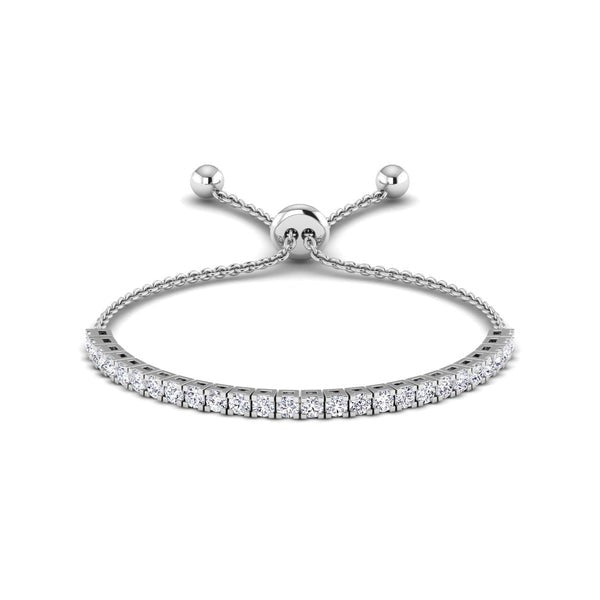
With chain bracelets: Delicate chain bracelets in the same or contrasting metal alongside a tennis bracelet create a texture contrast — the chain's open, linear character alongside the tennis bracelet's dense diamond coverage. The combination works best when the chains are substantially lighter in visual weight than the bracelet, maintaining the tennis bracelet's primacy while adding movement and variety at the wrist.
As a solo piece: The tennis bracelet requires no stacking partners. Worn alone on a bare wrist, it creates a complete wrist presentation without the effort of composed stacking — the continuous diamond line provides its own visual completeness. For buyers who do not typically wear multiple bracelets or who find wrist stacking more effort than they want to invest daily, the single tennis bracelet is a self-sufficient choice.
Grown Leo's Commitment to Tennis Bracelet Quality
A tennis bracelet represents a different kind of quality commitment than a single-stone ring because every link in the piece must meet the same standard — not just the most prominent stone or the most visible setting. Consistency across 30 to 100 individual settings is a more demanding fabrication requirement than excellence in a single stone's setting, and it is one that distinguishes quality bracelets from adequate ones.
At Grown Leo, every tennis bracelet is inspected link by link before shipping — prong integrity, stone security, setting alignment, and clasp function are all assessed for the complete piece rather than sampled from representative sections. The diamonds are matched for color and cut quality before assembly — the bracelet's visual consistency is designed in rather than hoped for. Metal content is verified by alloy specification rather than assumed from supplier representation.
Every tennis bracelet ships insured and tracked, with documentation of total diamond weight and grade specifications, a lifetime craftsmanship warranty covering setting and clasp integrity, and a 30-day return window for unworn bracelets in original condition. Our team answers specific questions about specific bracelets — their total carat weight in context, their individual stone sizes, their clasp type and security mechanism — before the purchase is placed.
Caring for a Lab Grown Diamond Tennis Bracelet
A tennis bracelet worn on the wrist accumulates contact with more surfaces and more substances than a ring worn on the finger, which means its cleaning and maintenance needs are slightly more frequent than equivalent ring care.
Cleaning: Warm water and a small amount of mild dish soap, worked along the full length of the bracelet with a soft brush, removes the accumulated skin oils, hand products, and environmental deposits that reduce diamond brilliance and accumulate in the individual settings. The inner face of the bracelet — which contacts the wrist continuously — requires particular attention, as this surface accumulates the most residue from skin contact. Rinse thoroughly under running water and dry with a lint-free cloth, opening the clasp to access the clasp mechanism's recesses during the drying process.
Clasp maintenance: The double-safety box clasp should be checked periodically for its engagement feel — a properly functioning clasp clicks positively into both the primary and secondary closed positions. A clasp that feels loose in either position, or that requires excessive force to open or close, should be assessed by a jeweler before continued wear. Clasp failure is the primary cause of bracelet loss and the one most preventable through periodic inspection.
Prong checks: Annual professional inspection of the prong settings along the bracelet's full length catches developing wear at individual prong tips before it compromises stone security. A bracelet's many individual settings mean that any given inspection covers more prong positions than a ring inspection — the process takes longer but addresses the same essential question: are all stones held as securely as they should be?
Activity removal: Remove the bracelet before activities that create concentrated chemical exposure — chlorinated pools, household cleaning products — and before activities involving heavy or repeated impact on the wrist. Both conditions are uncommon in typical daily wear but specific enough to be worth noting for active wearers.